
How to compose an award winning image
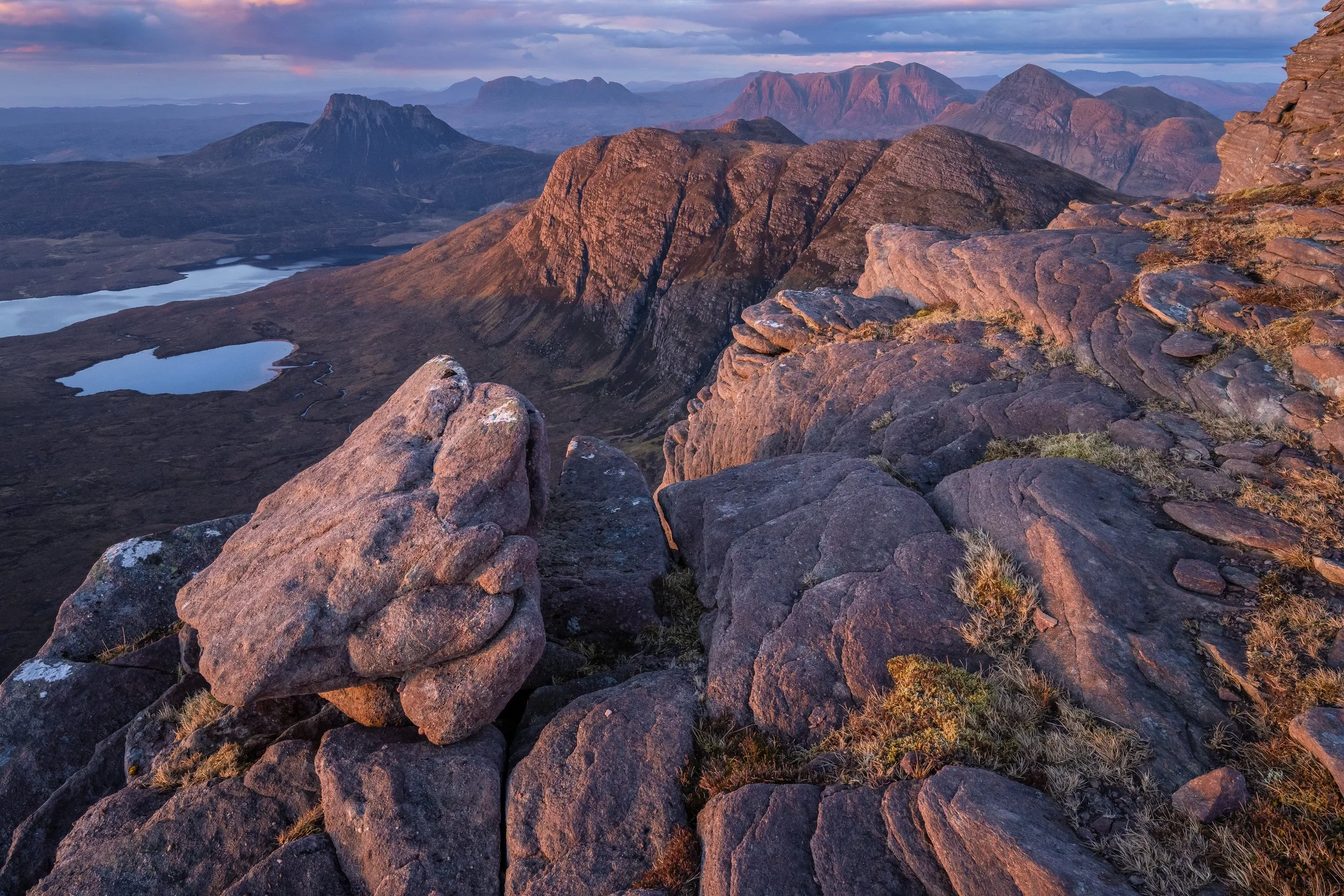
'Allure' - Mountains of Assynt from Sgùrr an Fhìdhleir, Coigach
Mountains, Winner - Natural Landscape Photography Awards 2025
As with most good stories, it makes sense to start at the beginning.
Ascending the loose and pathless ground on the south-west shoulder of Beinn Mhòr na Còigich wasn’t made any easier by a glance over the shoulder towards a heavy downpour just off-shore, looming slowly towards me. Thankfully, an accompanying break of light also allowed for some great photographs and a timely break from the two-up, one-down battle that I was waging with my foot placements whilst hiking uphill. The rain came, the waterproofs adorned and duly removed as the rays of sunlight playfully danced across the landscape and chased the shower away to the north, leaving faint traces of rainbows in their wake.
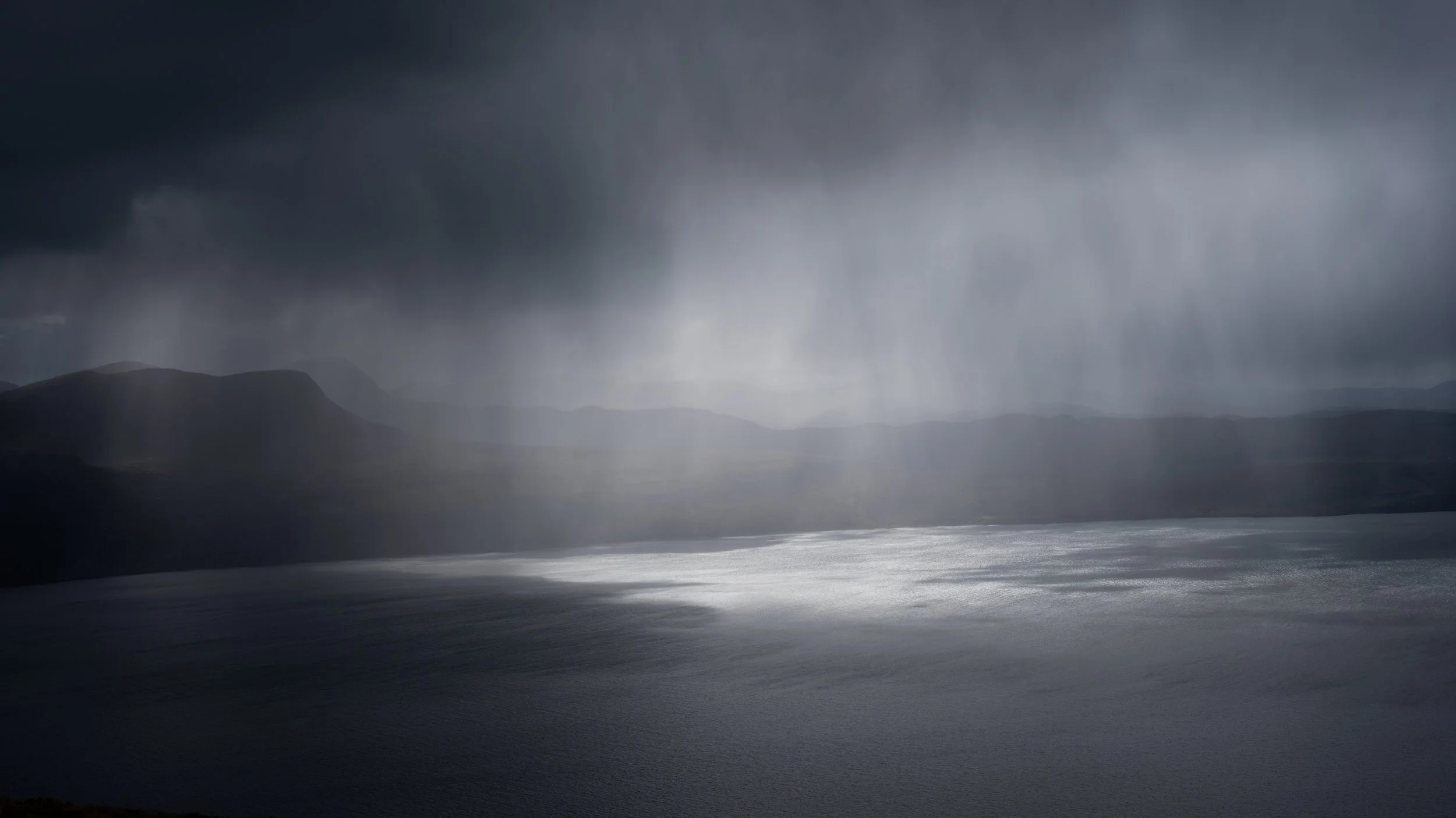
Rainfall over Annat Bay on the ascent of Beinn Mhòr na Còigich
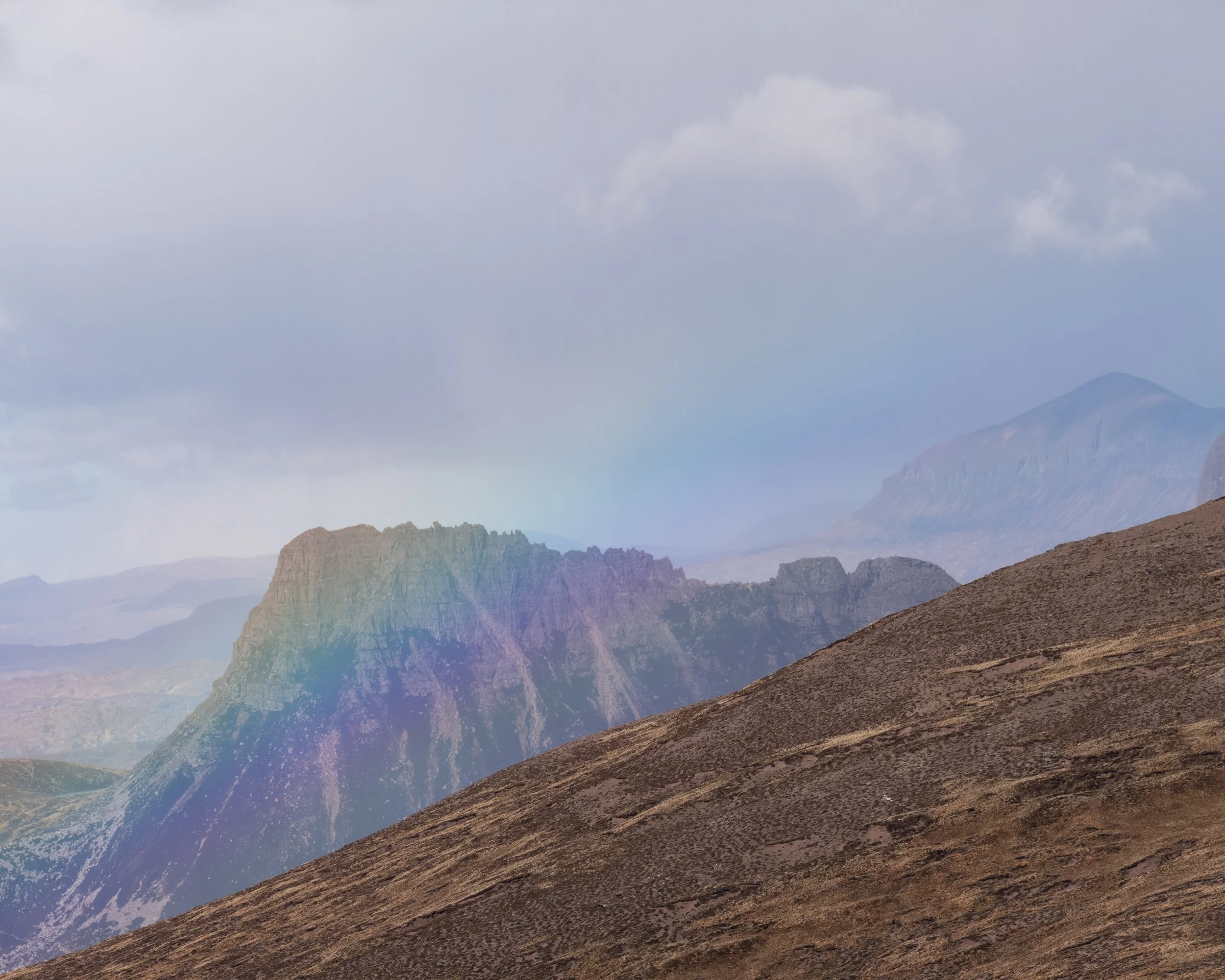
Rainbow over Stac Pollaidh from the ridge of Beinn Mhòr na Cuòigich
‘Why are you starting here?’ I hear you wondering. I suppose the tendency would be to cut straight to the chase. An award winning image - that doesn’t happen every day. That’s what you’re all here to learn about, right? The truth of it is, when I started thinking about how to approach writing this article, I quickly realised that my whole experience from the day, leading up to that special moment at sunset, contributed to the final image.
The gradient eased and I was greeted by some splendid terraces of sandstone, which provided some easy scrambling to attain the higher ridge of the mountain. When viewed from sea level across the bay from Ardmair, Beinn Mhòr has a quite striking profile, resembling a vast wall of rock. In my childish imagination, the mountain looks like an ancient fortress. This characteristic is shared by many of the sandstone giants in the northwest Highlands. And yet, much like the others, when perched upon the narrow crest, you realise it is not so broad as it may have seemed from below at all. A series of delightful discoveries were made henceforth, as I continued along the ridge, with a number of twisted monuments greeting me along the way. Geologists suspect that these gnarled figures are caused by soft-sediment deformation, likely shaped by ancient earthquakes before they were able to harden. There are a number of notable examples across the region of Assynt and Coigach.
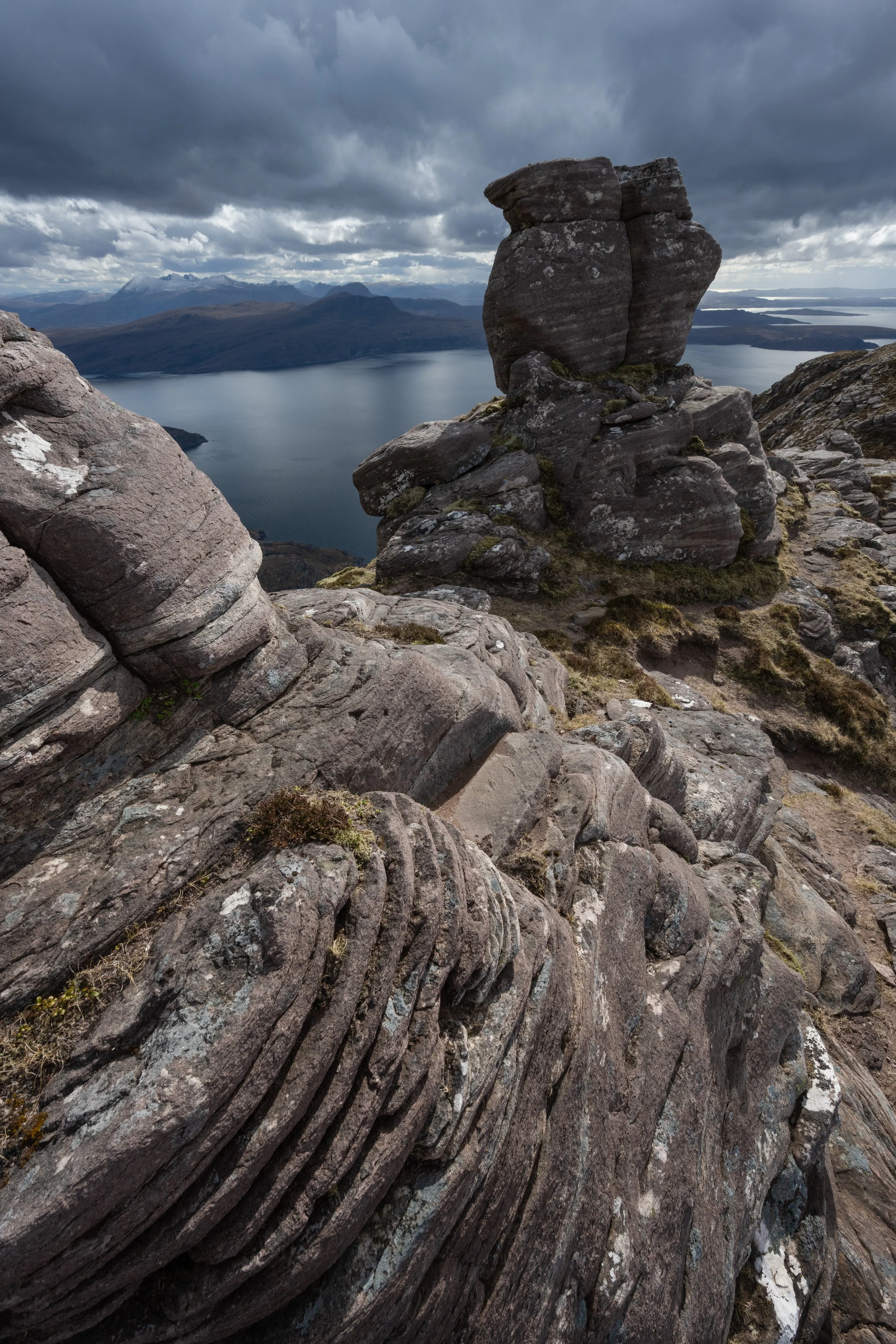
Soft-sediment deformation on the ridge of Beinn Mhòr na Còigich
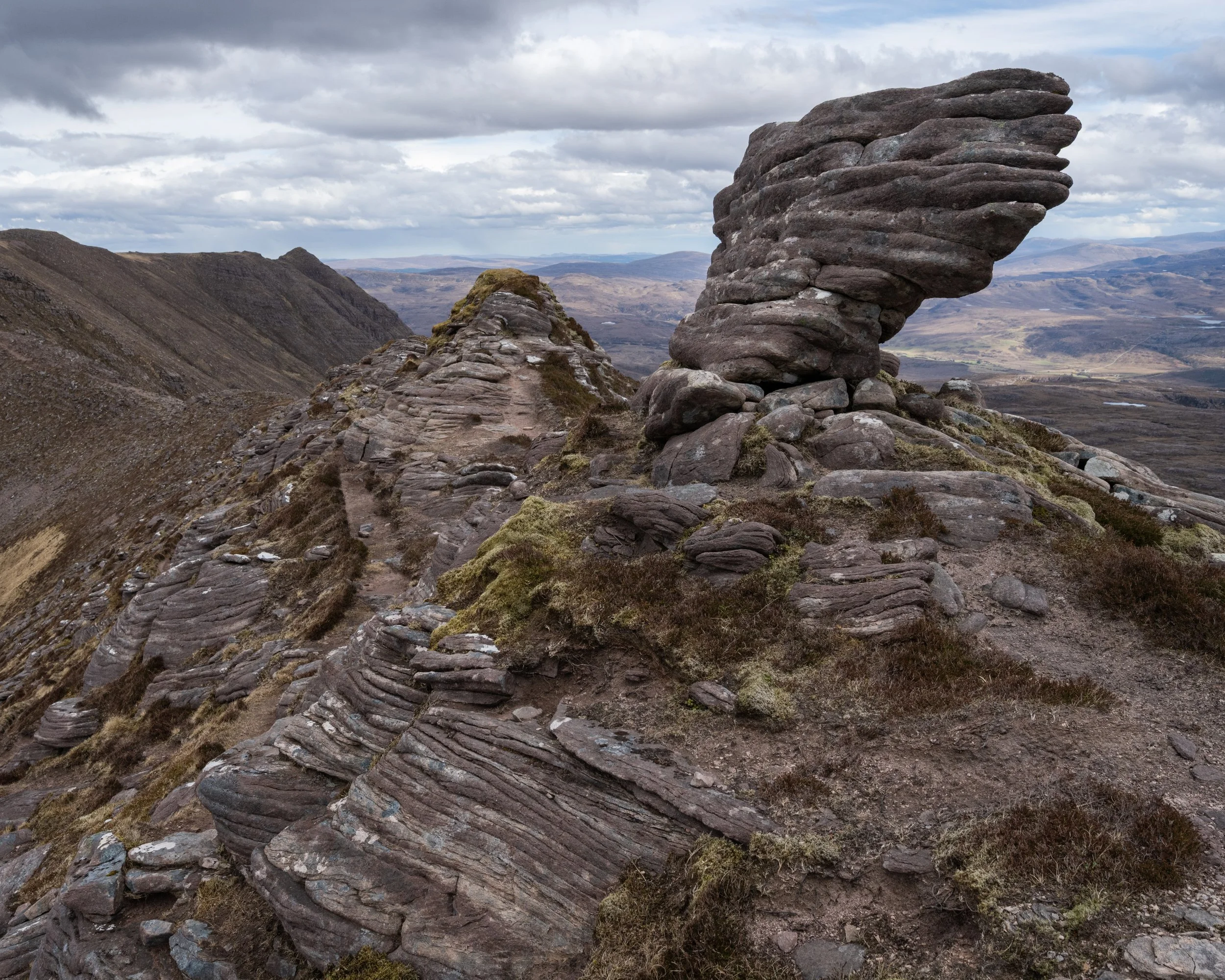
More twisted and gnarled structures on the ridge of Beinn Mhòr na Còigich
It would be remiss of me not to acknowledge the sad circumstances that led to the stark and bold appearance of Stac Pollaidh that day. This is a mountain of modest height yet unsurpassed character, loved by many. A few days prior, a fire caused by the heedless negligence of a visitor had scorched the mountain and the surrounding landscape, destroying many habitats and likely causing the death of a lot of wildlife. This is inexcusable to me. Too often I observe disgusting behaviour by people, sometimes it can have monumental consequences. I urge everybody to contribute to the safeguarding of these delicate places by following the basic and fundamental principle of leaving no trace and encouraging others to do the same.
Thankfully, the area has recovered and the smell of charred ground is now long gone, yet the black outline of Polly in ‘Allure’ serves as a permanent reminder of our duty and obligation to the landscape - for me it least.
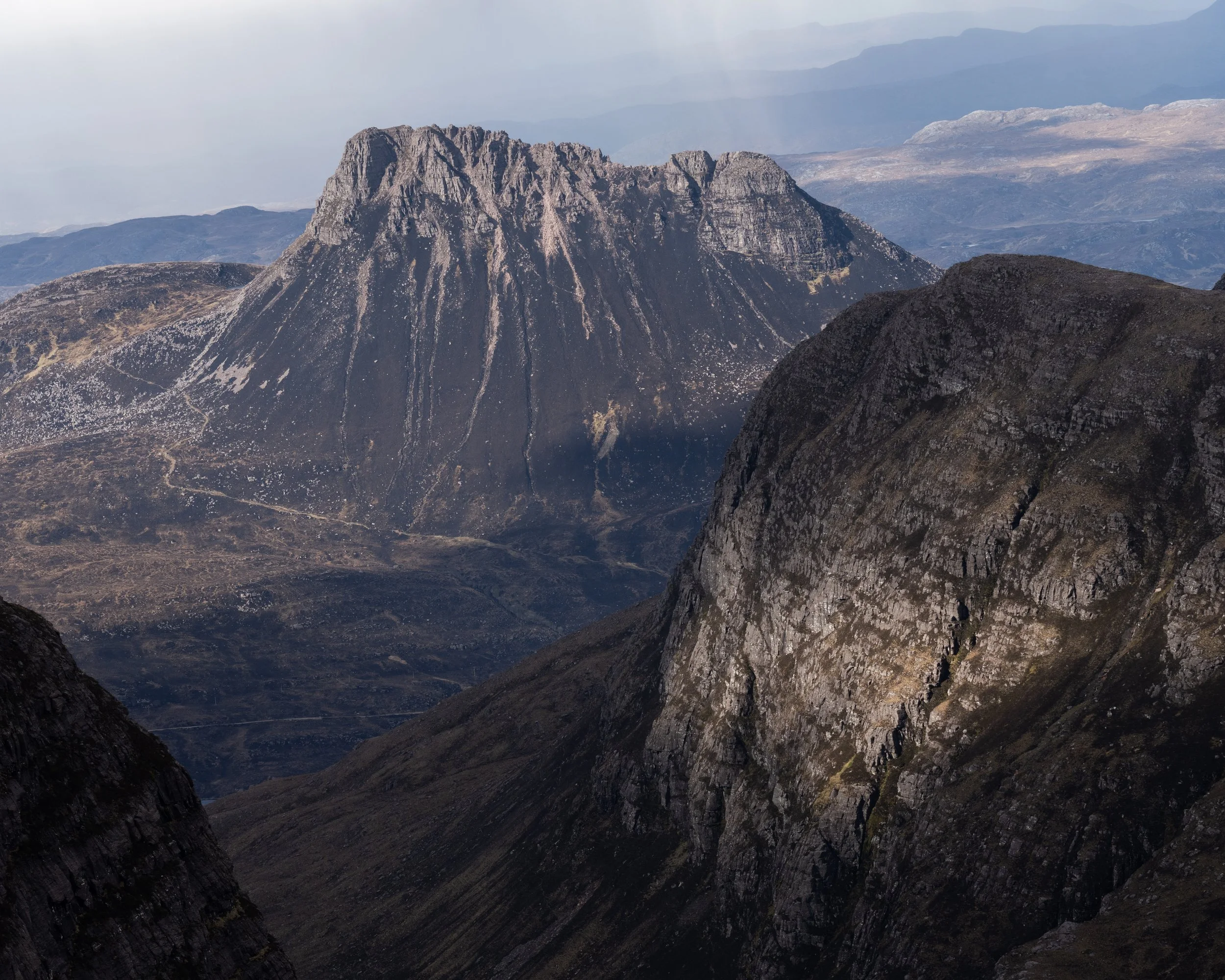
Charred Stac Pollaidh after wildfires in April 2025
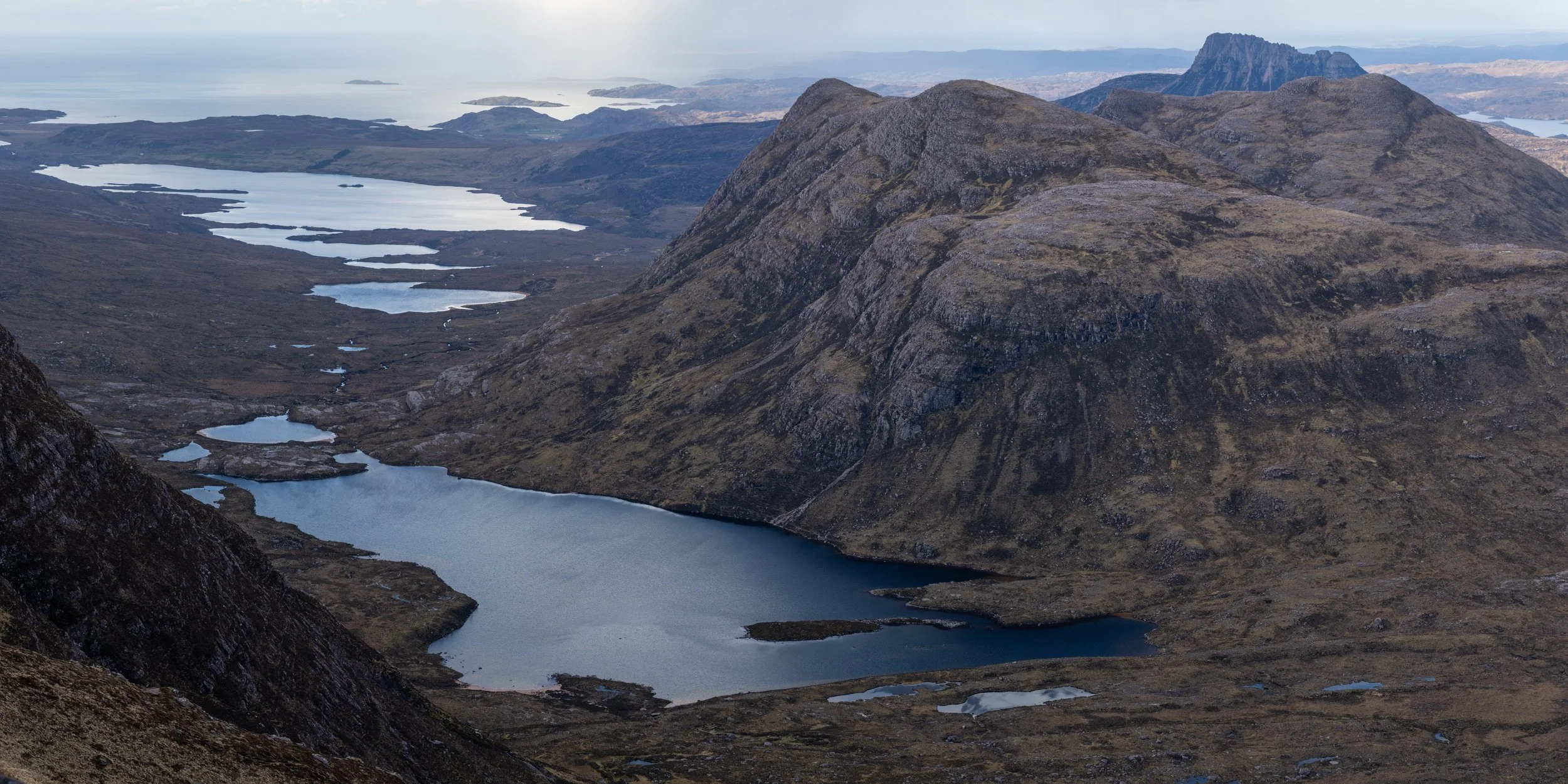
Hide and seek - spot Stac Pollaidh! The type of rugged terrain typical of the Northwest Highlands.
More opportunities arose as I reached the bealach on the continuation towards Sgùrr an Fhìdhleir from Beinn Mhòr, with an interesting alternative perspective of the view that I would soon enjoy from the former. The impressive view of the hills to the north is somewhat restricted here at this lower elevation. The dominant hind of Beinn an Eòin blocks a lot of the vista, although there is enough interest to attempt to piece a composition together here.
The peaks peeking out; the small lochans in the glen below and the aesthetic examples of sandstone combine for a somewhat compelling scene, particularly when combined with a rainbow! Nevertheless, the anticipation of what awaits just one hundred and fifty metres higher to the northwest is more than sufficient to move swiftly on - though I may return here one day to refine this composition and hopefully get some more dramatic lighting.
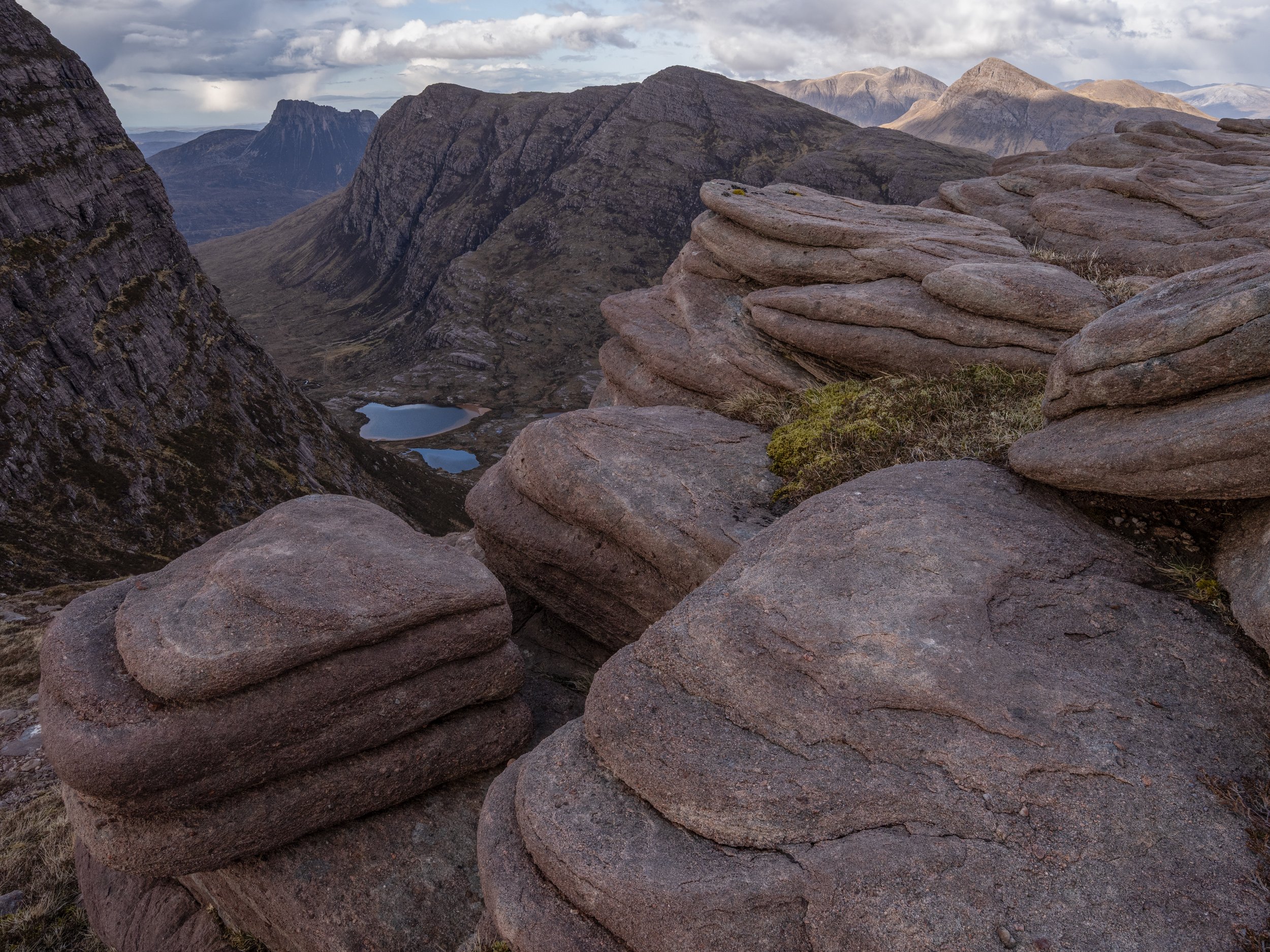
A hint of what’s to come…?
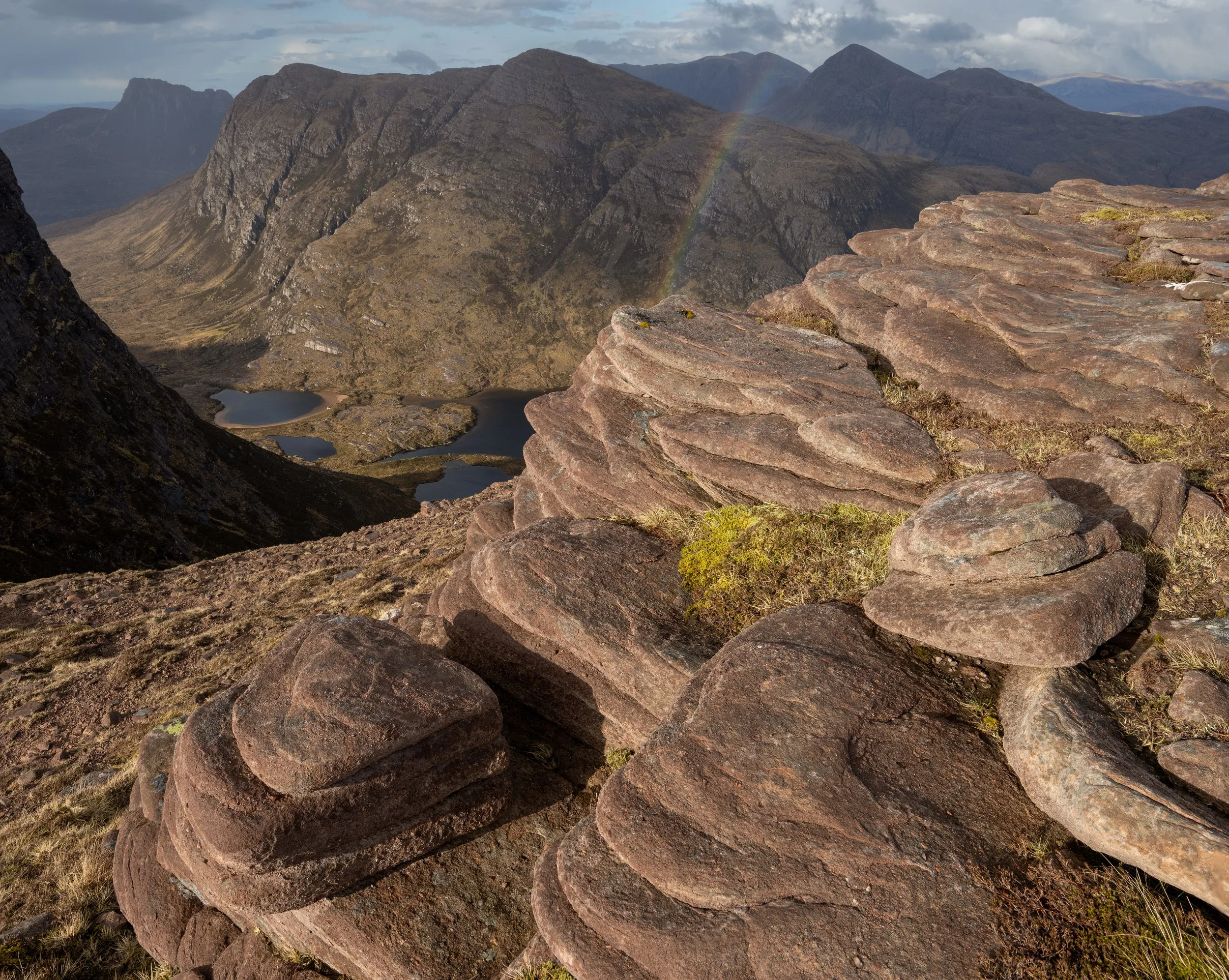
… Hopefully!
There are many words or metaphors that I could use to try and describe the experience of standing atop the summit of Sgùrr an Fhìdhleir, instead I am going to allow one photograph to do the talking for me, with a brief description. The sheer scale of the pyramidal mountain is encapsulated in this image - a telephoto perspective depicting its shadow upon the loch-laden glen far, far below. Let me say only this, it is not a place to find oneself in strong winds!
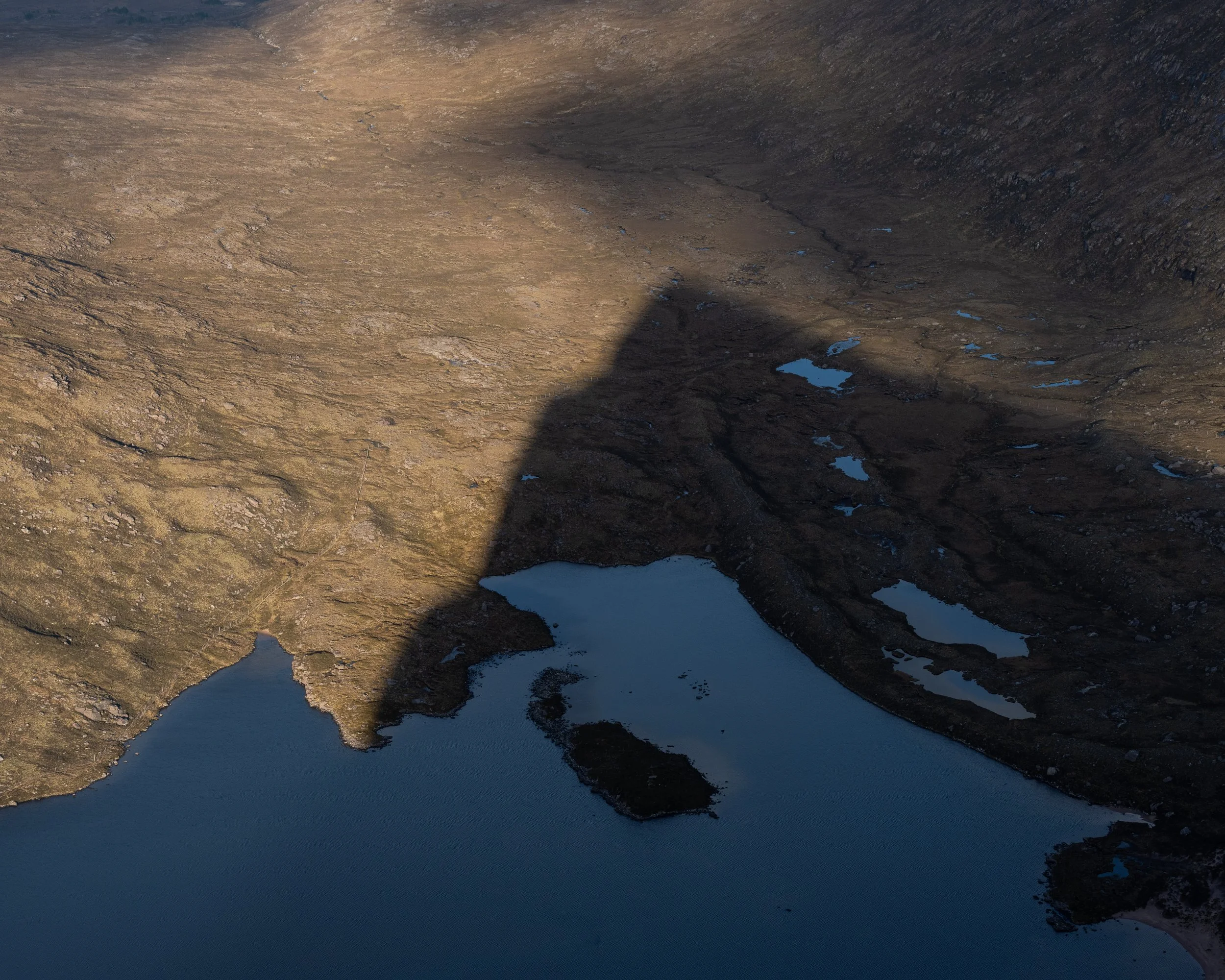
The shadow of Sgùrr an Fhìdhleir looms below, showing off the pyramidal form of the mountain
The jeopardy is only increased by the staggering and distracting view directly north. Whilst the ground before me plummeted downwards, the spectacle for the eyes soared. This is the perfect time to retreat along the escarpment to allow full enjoyment of the view without the looming certainty of oblivion just a few steps away! Conveniently, this is also where some of the optimal photographic opportunities are too.
A brief exploration of the multitude of foreground opportunities led me to the striking character perched on the edge of the precipice and I instantly knew this was the scene that I wanted to perfect in time for the sunset, probably inspired by the other sandstone gargoyles that I had encountered earlier that day.
Composition Discussion.
I am going to concisely write about my thought-process when approaching the composition of this scene and the decisions that led to the final arrangement, starting with the foreground subject (let’s refer to it as the gargoyle, why not?)
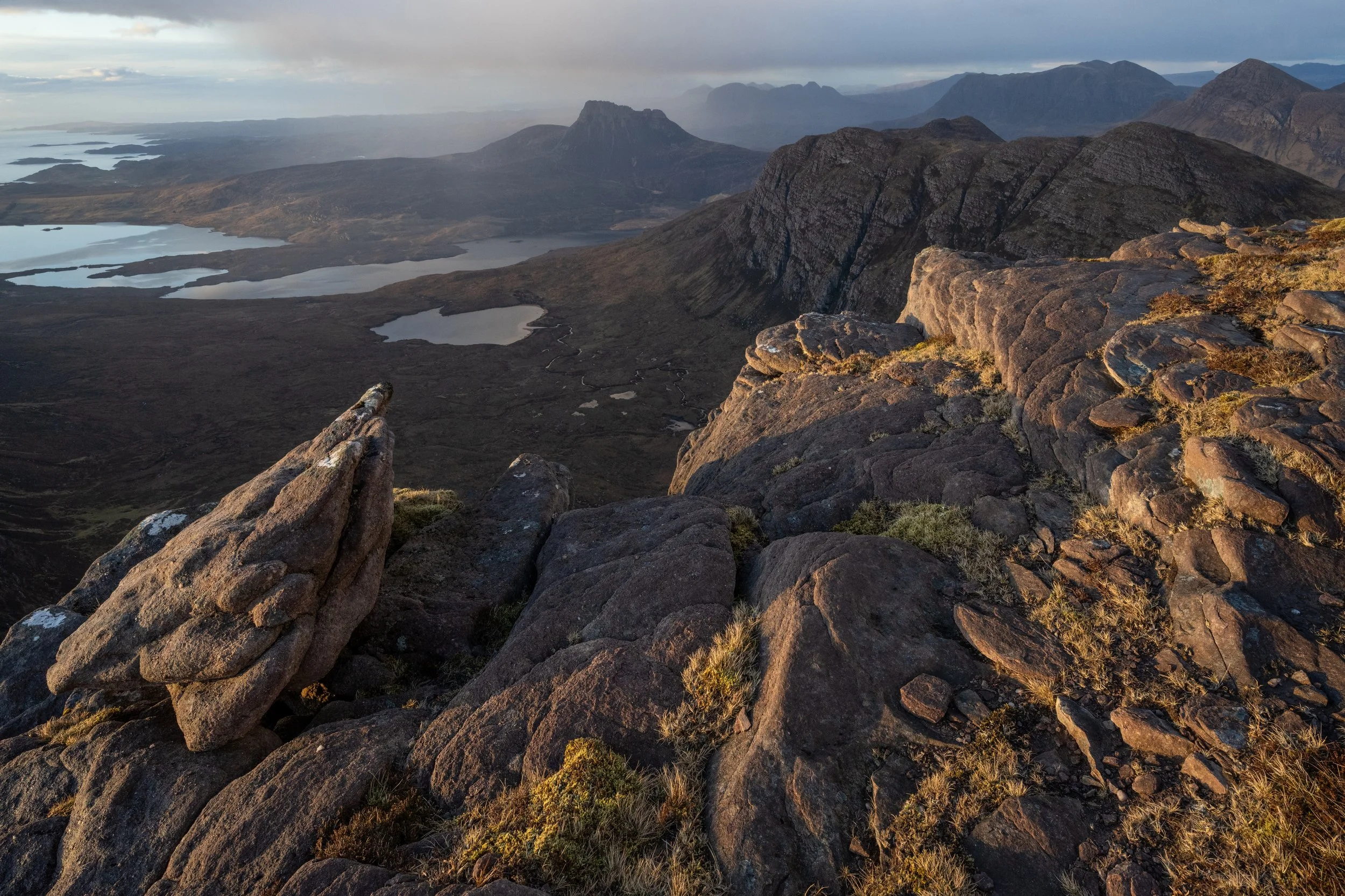
Trial and error - a first attempt at composing the scene that failed to address a few issues
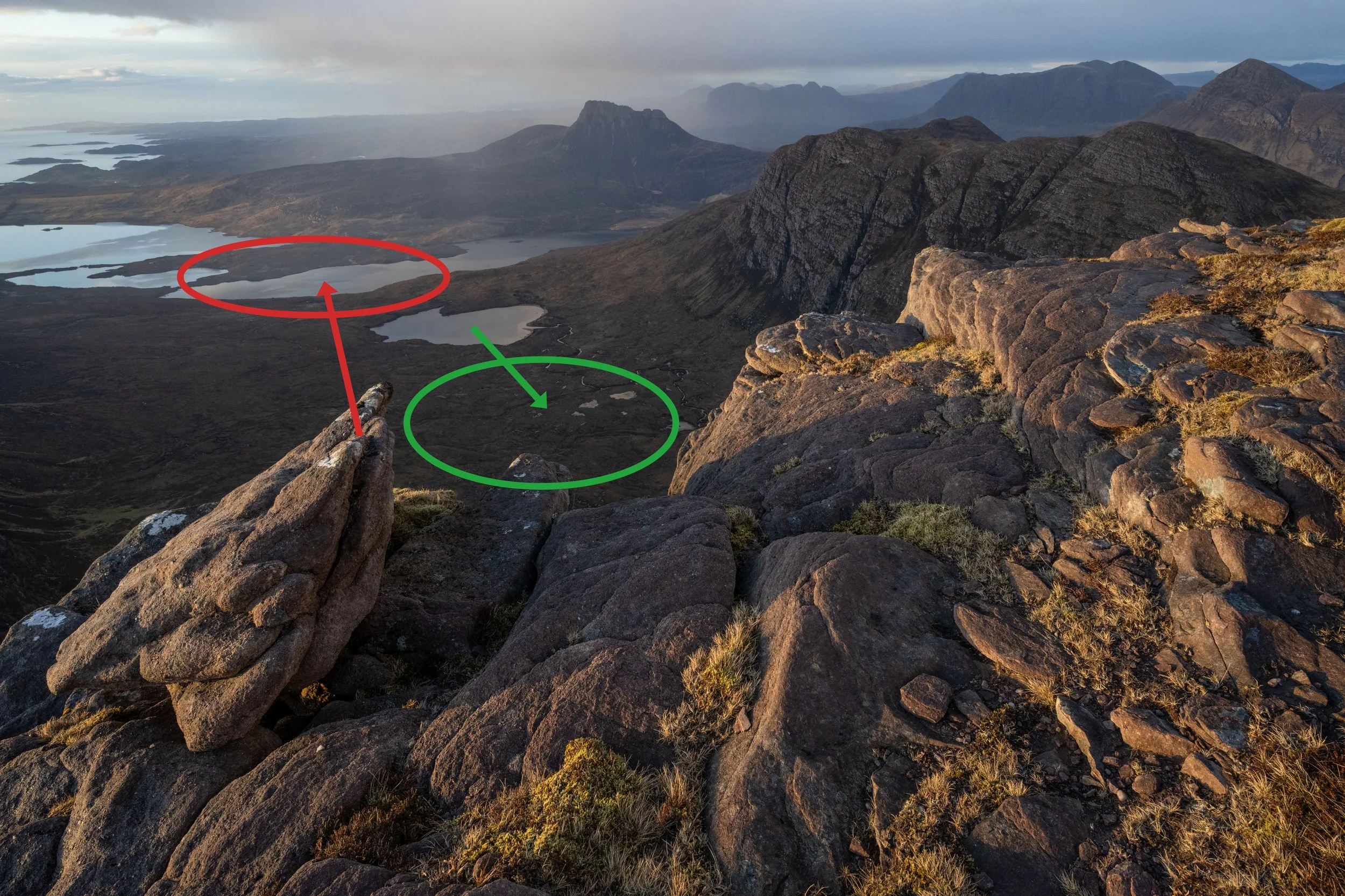
Initially, I wanted to emphasise the sharp profile of the gargoyle by positioning it on the far left of the frame, which maintained the shape of its pointy extremity. This also served a secondary purpose for which I had originally intended: to neatly position the small circular shaped lochan in the mid ground within the convenient gap between my foreground elements (circled in green).
However, this placement of the lochan meant I had to lower my camera position consequently shifting the perspective, resulting in the gargoyle intersecting the larger loch in the midground and causing a jarring distraction between these two important subjects within the scene (red circle).
Juggling the jigsaw - the pieces weren’t quite fitting together yet
After some more careful tweaking, I eventually settled on this arrangement.
There is always compromise in photography, I’ve found. A minor annoyance in your compositions here or there, although on this occasion the only compromise I suffered was having to yield my initial stubbornness. The moment I let go the idea of framing the midground lochan and working with my subjects, rather than fighting them, my vision was realised.
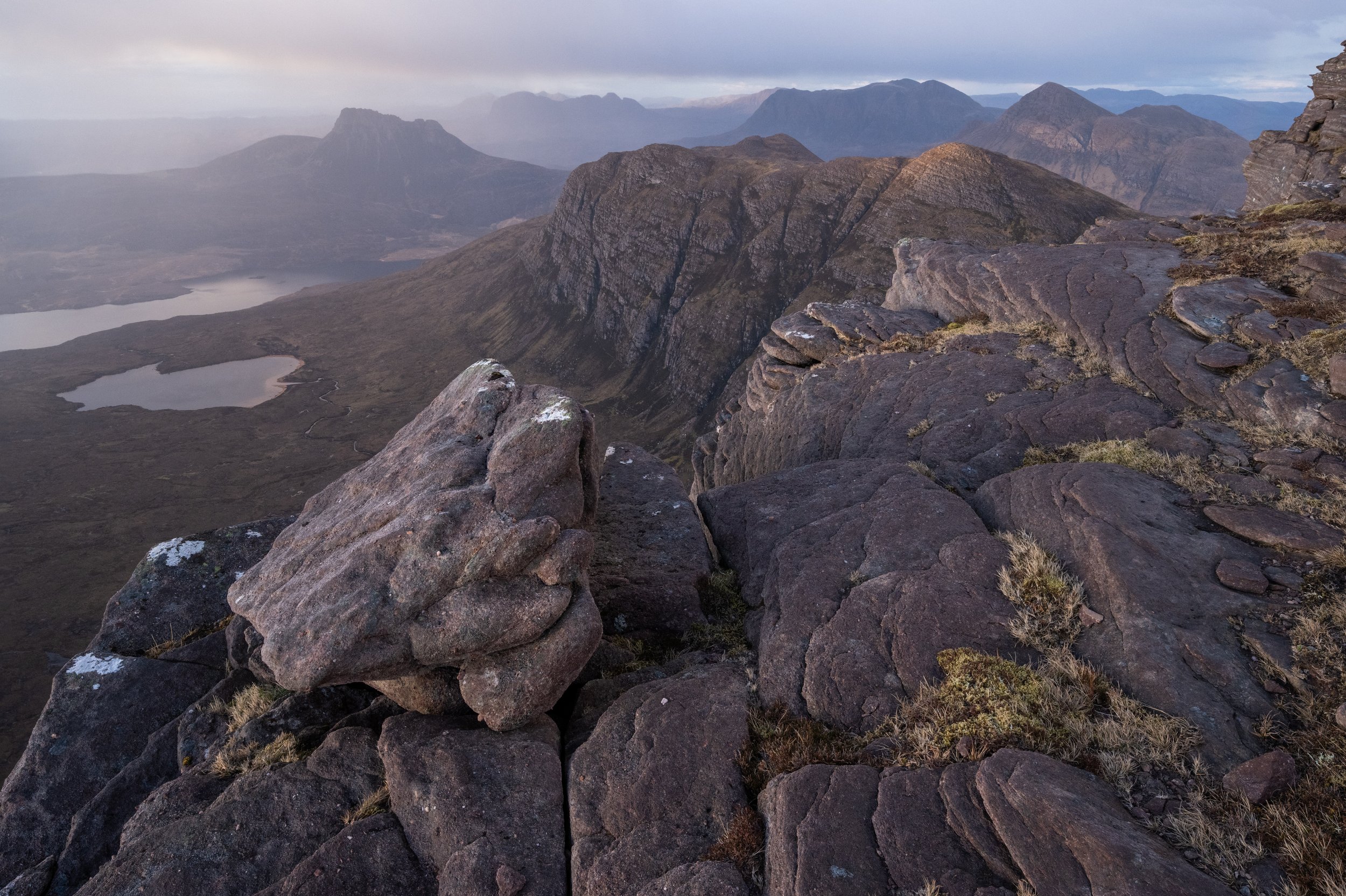
Finding balance - a far more harmonious arrangement after I yielded my initial stubborness
My background was now balanced - with an improved distribution of the mountains across the top of the frame. I was careful to select a focal length that maintained their prominence rather than diminish them into insignificance.
I was able to align a near perfect diagonal from bottom left to top right, cutting my scene into two, yet maintaining their connection with both the literal and implied converging lines (green lines) and directionality of the visual flow within the composition, culminating with the scorched silhouette of my main background subject: Stac Pollaidh (white circle).
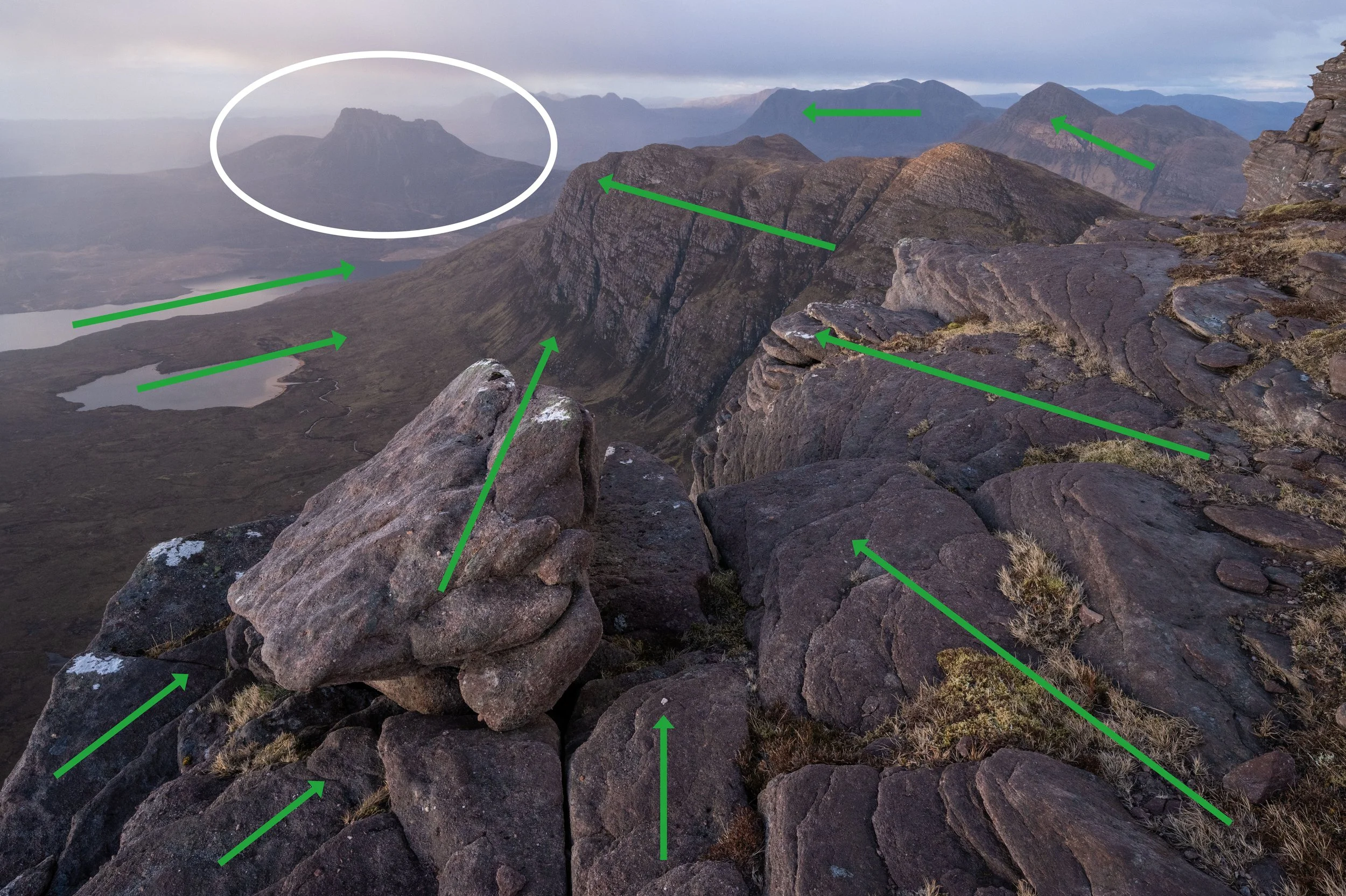
Visual flow - connecting immediate foreground, midground and background with careful consideration of the main subjects within the scene.
This is a strong example to illustrate the importance of considering the edges of an image. It would have been easy in this instance to notice the cool gargoyle, plonk it in the foreground and wait for the best light. But, with careful observation of the very immediate foreground, I was able to utilise the graphic features in the sandstone to my advantage, providing a strong anchor at the very base of the image. I was also careful to allow the other elements in the scene a more appropriate amount of space relative to the edges of the frame, eliminating those jarring distractions from the initial attempt.
Lastly, the very subtle highlights on the sandstone provided me with an indication of how the light would fall across the scene at sunset (should it arrive), a very useful tip to utilise if you have time to prepare your composition when waiting for a sunset or sunrise and the conditions allow for it.
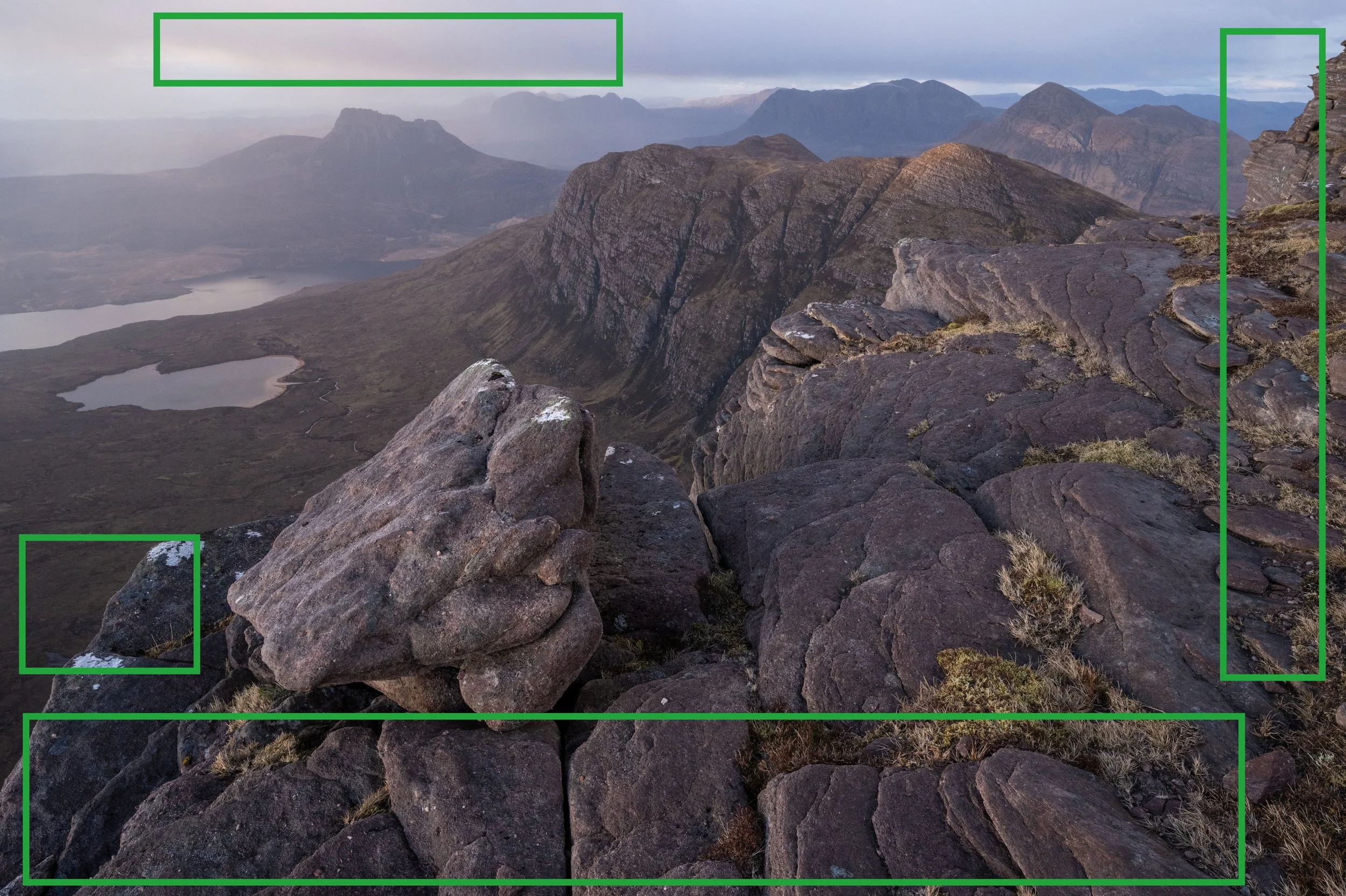
Edgy! - allowing appropriate space on each edge improved the balance of the image overall.
As the time ebbed away, it was unclear if the illusive light would ever arrive, but just minutes before the sun dipped below the horizon - it did just that. It was a soft light. Not necessarily subtle, but certainly not overpowering. It slowly brushed its way across my canvas, painting my scene with a beautiful crimson glow, accentuating the natural tones in the sandstone quite perfectly. The gargoyle and I stood side by side, both frozen and (I like to imagine) mesmerised by the alluring beauty that had unveiled before us.