
Assynt & Coigach
The Ultimate Guide to Landscape Photography
A complete guide to landscape photography in one of Scotland’s most spectacular mountain landscapes, including the best locations, seasons, conditions and practical advice from years of exploring the area.
Quick Navigation:
Why Photograph Assynt & Coigach?
In truth, this is something of a rhetorical question. Most of you will have seen at least a handful of images from the region and will already understand the appeal of landscape photography in Assynt & Coigach.
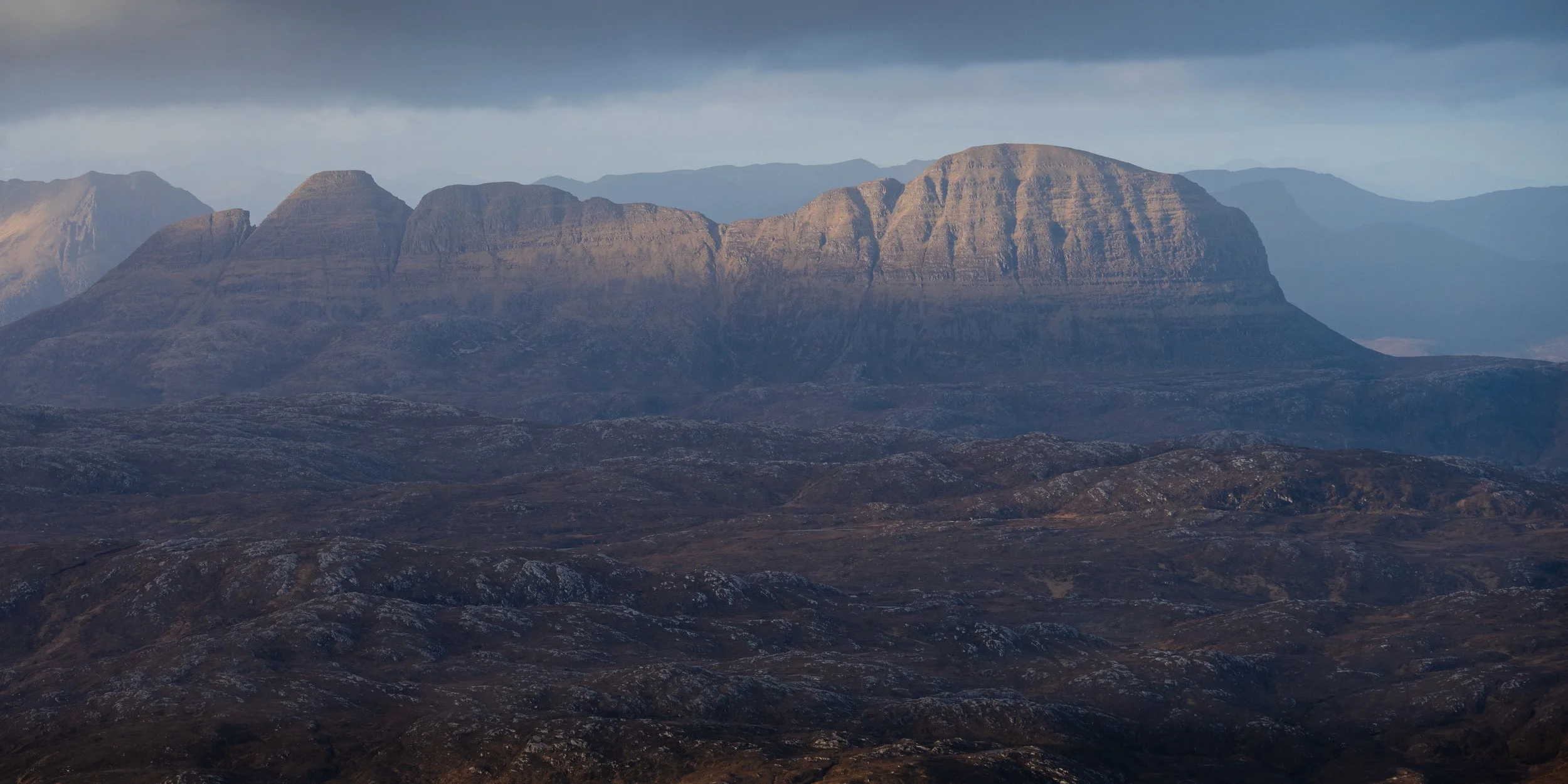
There is a uniqueness to Assynt & Coigach that is unmatched in any other region of Scotland, indeed unlikely anywhere else in the world. In many ways, it is difficult to explain using words alone and perhaps that is why many of us would resort to photographing Assynt & Coigach instead. Maybe it’s the mountains? The iconic profiles are undeniably more than just an amalgamation of rock and earth piled on top of each other. Suilven, Stac Pollaidh, The Fiddler - each one seems to have its own individual personality, character and secrets just waiting to be unveiled. Perhaps it’s the coastline? Sparkling blue oceans, towering sea stacks and pristine white beaches. Achmelvich Bay, Clachtoll, Stoer Beach - each one a jewel along the winding treasure trove of the shore. Or possibly its the cnoc and lochan landscape? Hundreds of little lochans littered amongst the many folds of the vast expanses in between each of the monolithic mountains. One idyllic journey along the mazy road to Lochinver provides you with an idea of the vastness of this area.
I imagine one would require an entire lifetime to be able to comprehensively photograph Assynt & Coigach. There are many possible perspectives to the different mountains and a vast, remote wilderness that will be hiding many unique foreground options. Seasonal variation is very noticeable here too, with the winter months bringing the possibility of snow to lower elevations and the summertime providing some optimal directionality of sunset and sunrise light. In this guide, I shall attempt to provide you with a foundational knowledge so that you too can go and experience the magic of Assynt & Coigach for yourself, and hopefully come away with some imagery that conveys what will undoubtedly have been a memorable experience for you.
If you would like to experience Assynt & Coigach with expert guidance, I also run small-group expeditions that explore some of the region's lesser-known corners, helping participants develop both their mountain photography, expedition skills and their understanding of this remarkable landscape.
Assynt & Coigach
At a Glance:
Region: Northwest Scotland
Best seasons: Summer, Winter
Physicality: Easy - Challenging
Best for: Mountains, Coast, Wild Camping
Where is Assynt & Coigach?
The exact boundaries for Assynt & Coigach may be somewhat contested depending upon the use case, for example, the historic parishes boundaries differ somewhat to the formal borders outlined in the Assynt-Coigach National Scenic Area (NSA) - which legally protects the region’s landscapes. I shall be referring to the latter in this guide, as this perimeter includes all of the main relevant locations for the purposes of photography.
I do feel strongly obliged to give honourable mention to the mountain range that forms Ben More Assynt and Conival - the only two hills that boast Munro classification in this area. The ridge adjoining the two summits is rugged and rocky, and provides some interesting opportunities for images with the iconic hills of Assynt in the background.
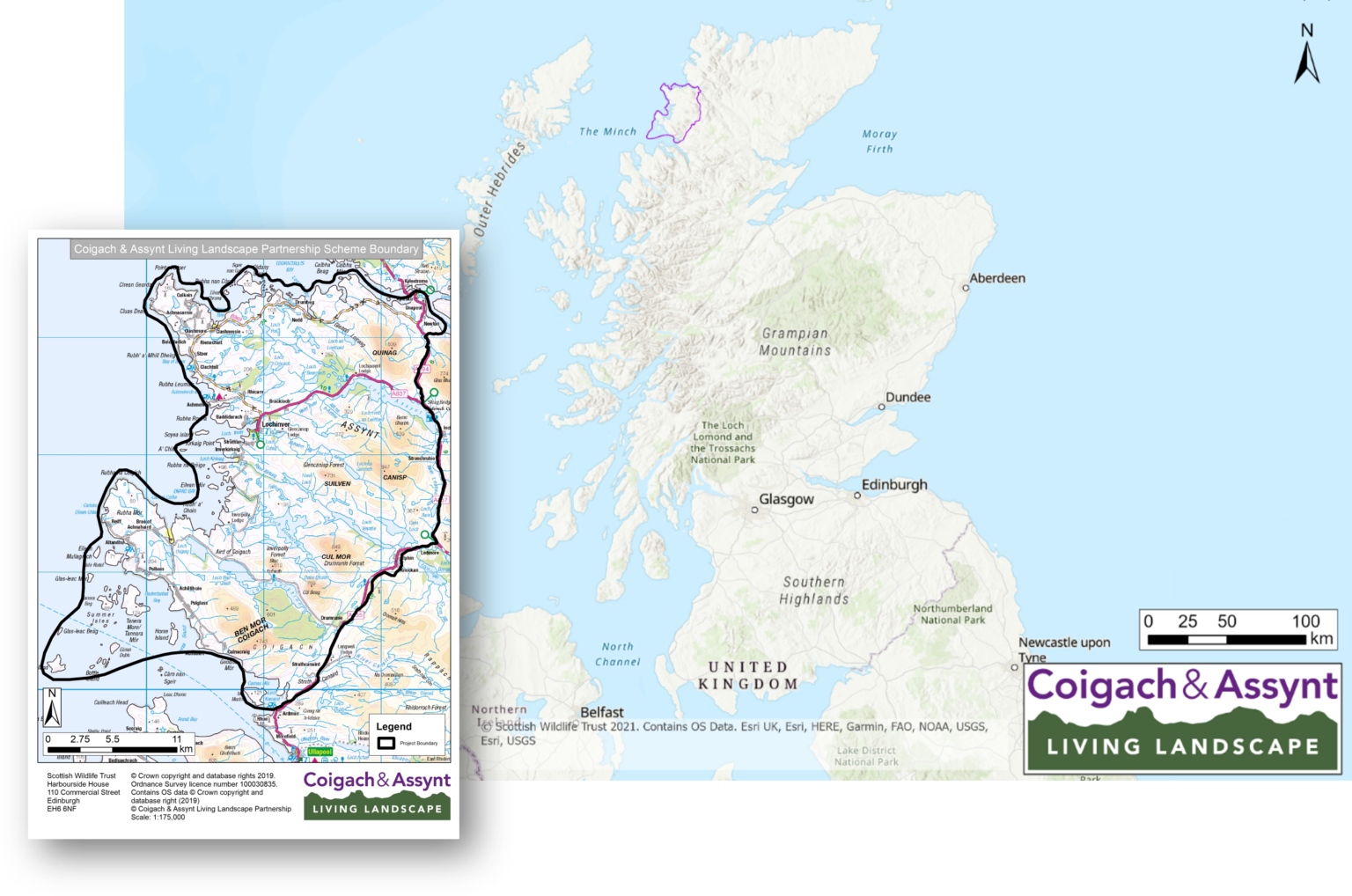
© Assynt & Coigach Living Landscape Partnership 2019
Boundaries
Assynt lies to the north and Coigach directly to the south. The precise boundary that adjoins the two follows a natural waterway from west two east: the River Kirkaig, Fionn Loch and Loch Veyatie. When observed as independent districts, the boundaries are clearly established by natural elements within the landscape.
Assynt Boundaries:
North: The marine waters of Eddrachillis Bay and Loch Glencoul, near Kylesku.
West: The Atlantic Ocean, indented with rocky bays - Clahtoll and Achmelvich.
South: The River Kirkaig, Fionn Loch, Loch Veyatie line (bordering Coigach)
East: Long ridge of inland mountains, culminating in Conival and Ben More.
Coigach Boundaries:
North: The River Kirkaig, Fionn Loch, Loch Veyatie line (bordering Assynt).
West: The Minch, Ennard Bay, Summer Isles and the Rubha Còigeach peninsula.
South: Loch Broom and Ardmair Bay (just north of the port town of Ullapool).
East: Formed by the single-track road/glen, Strathkanaird, leading up to Elphin.
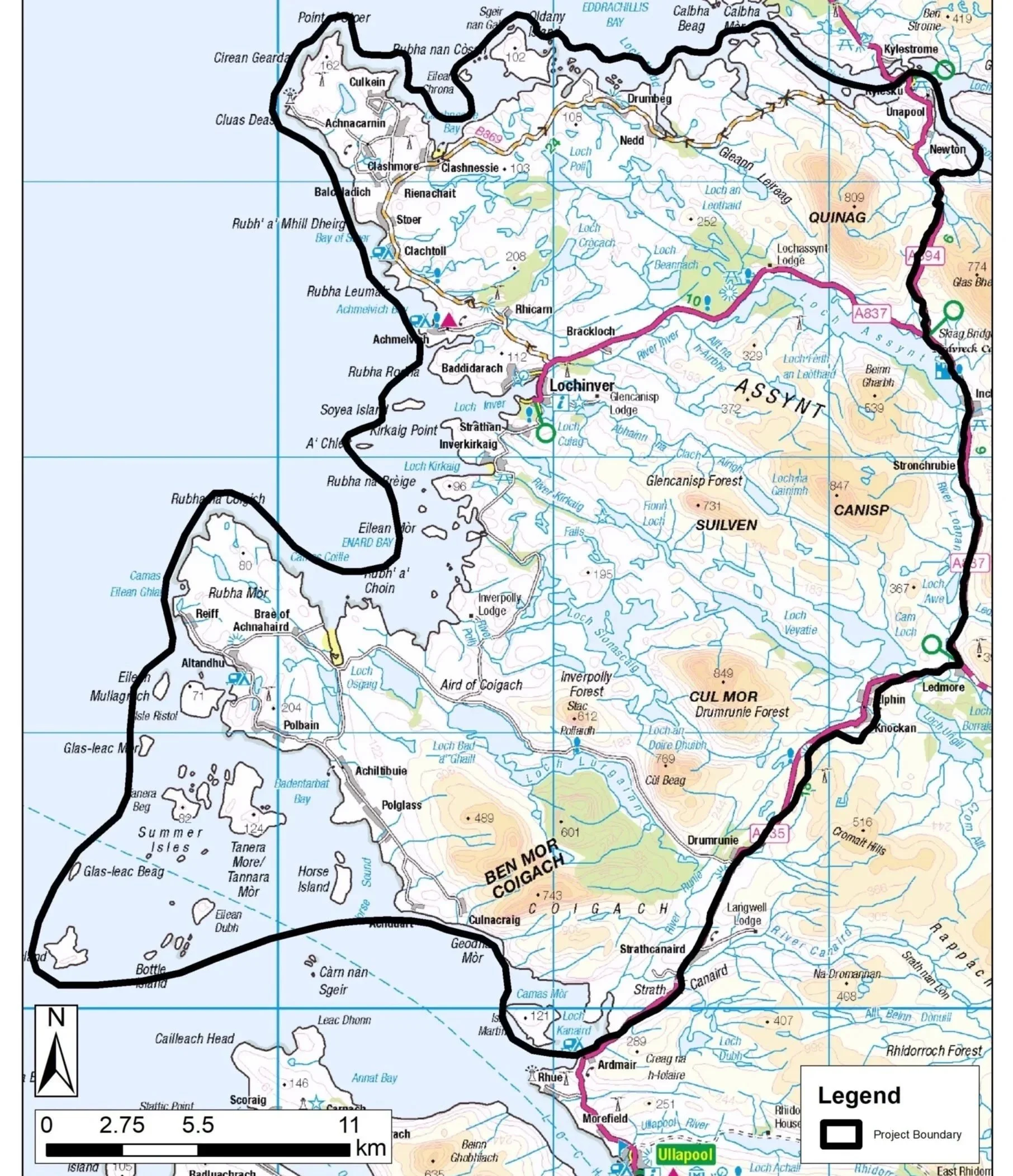
© Assynt & Coigach Living Landscape Partnership 2019
Access Information
The landscape of Assynt & Coigach is extremely delicate and visitors must be respectful and responsible of a number of key considerations. Public access in Scotland is legally protected, however this is entirely dependent upon your behaviour. I strongly encourage anybody planning a visit to ensure their time in the region is not detrimental to the landscape and leaves no identifiable trace. I imagine that the vast majority of readers will empathise, it is generally just common sense after all, however there is a growing minority of individuals that do visit and seemingly have no regard or care for the impact left in their wake. If you are one of those individuals, please simply stay away and reconsider your life choices.
Now that rant is over, some information regarding those aforementioned key considerations.
Parking & Vehicle Access:
Single Track Lanes: Most of the roads threading though Assynt & Coigach are narrow, single tracks lanes with passing places, with a national speed limit applied (I highly advise you do not meet this limit, drive slowly with consideration to other road users and wildlife).
Passing Place Rule: You must not park in passing places or on roadside verges. Stop on the left hand side of the road. If the passing place is on the right, allow the oncoming vehicle to stop in the passing place. If there is a car behind you, pull into a passing place to allow them to pass - this is good manners. Locals will appreciate you doing this!
Parking: Use established car parks for your visits. For example. the car park on the Inchnadamph Estate for views/hike to Suilven; Stac Pollaidh walkers car park etc.
Responsible Visiting for Photographers:
Drone Regulations: Using a drone can be tempting for unique perspectives of the dramatic ridges on the mountains, but you must follow guidelines from the Civil Aviation Authority’s Drone Code. Be highly sensitive to the ground-nesting birds that are present during the spring/summer breeding seasons - disturbing wildlife with a drone is a criminal offence under the Wildlife and Countryside Act.
Peat Bog and Path Erosion: The terrain in Assynt & Coigach is very susceptible to erosion. Avoid trampling on fragile mosses and expanding muddy bogs where possible. Try to stick to established paths or rocky surfaces if you are wandering off-piste.
Stalking Season: Be aware of deer stalking activity between the July-October. Check the local estates planned shoots on Heading for the Scottish Hills service online.
Wild Camping Guidance:
Vehicle Distinction: parking in a campervan, motorhome or car for the night is not wild camping, this is overnight parking. Use designated campsites or parking bays that are not restricted by overnight parking.
No Open Fires: The ground in Assynt & Coigach is very peaty and susceptible to burning. There have been notable wildfires in recent years in the area causing immense damage to wildlife habitat. Use a self contained gas stove for cooking.
Pitching: Pitch for one night and then move on. Pitch later in the day and leave early where posisble to minimise impact. Strictly leave no trace. Waste management policy is to take everything home with you. For toileting, dig a hole and bury it. Do not leave toilet paper behind.
Best Time of Year to Photograph Assynt & Coigach
Call this sitting on the fence if you want, but in truth there is not a bad time to visit when it comes to photography. The mountains are equally resplendent doused in a white winter coat as a fresh summertime green one! That being said, there are some considerations that make specific locations preferable at different times of the year. Not to mention it is significantly busier in the summer season!
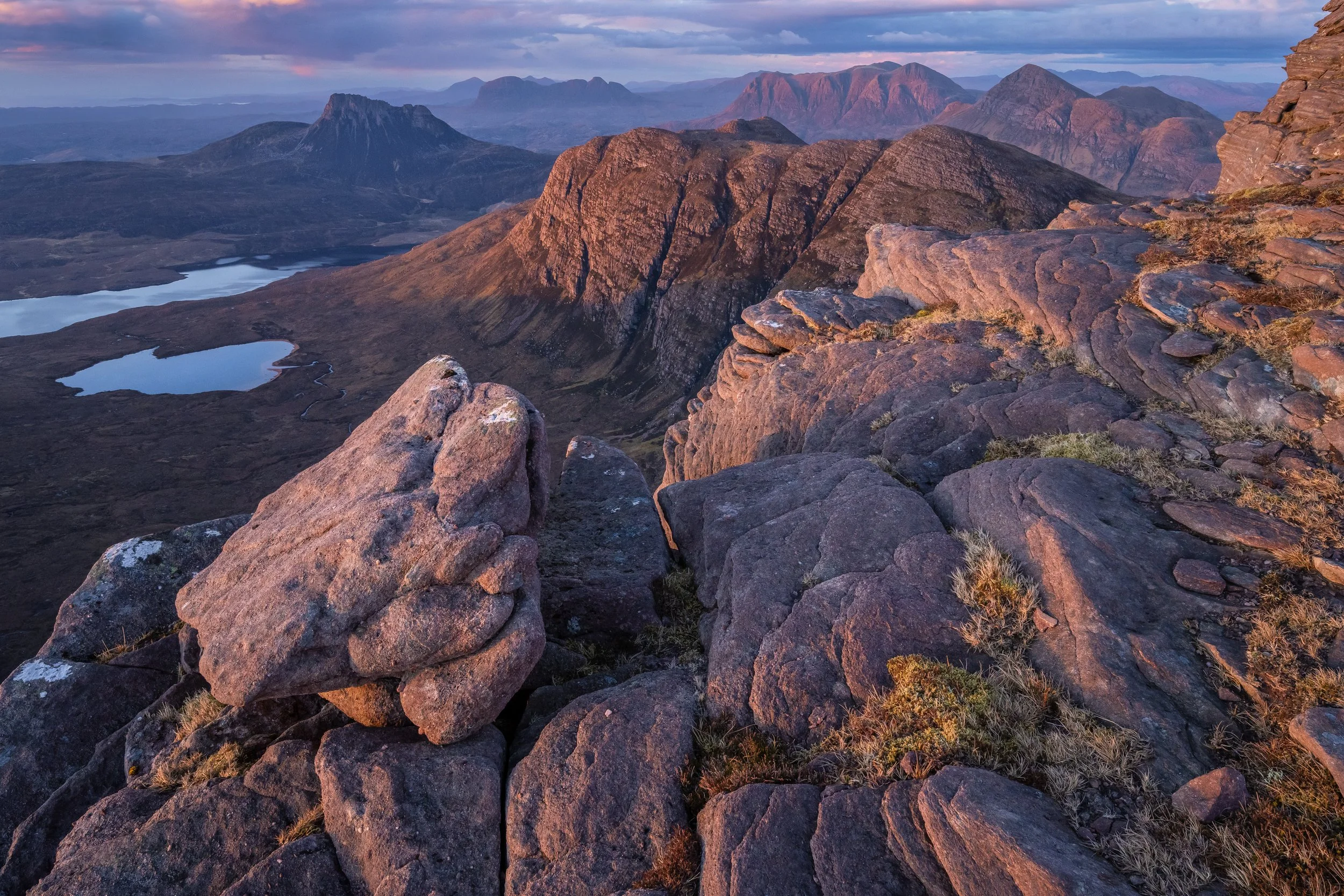
The changing angle of the sun throughout the year redefines which aspects on the mountains are best to photograph at different times. Notice the side-lit foreground, ridge of Beinn an Eoin and south west aspect of Cul Mòr in Spring’s image as an example.
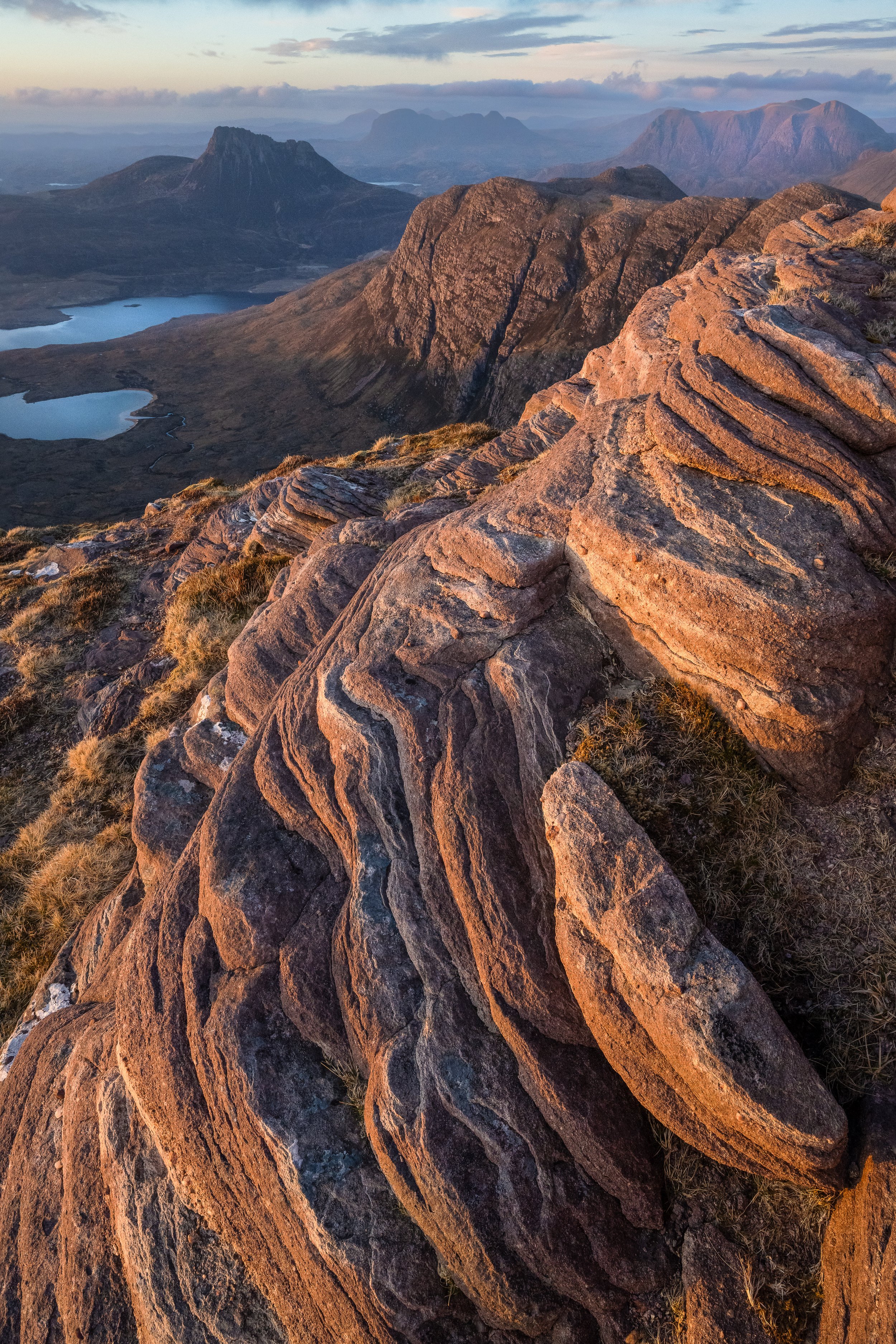
Spring - Stac Pollaidh from Sgùrr an Fhìdhleir
Spring (April - May)
I regard spring to be one of the optimal times of year to visit the Northwest Highlands in general for one reason - the midges have not yet emerged! It is also interestingly unpredictable. You could have heavy snowfall or you could have a week of high pressure and glorious sunshine.
Pros:
Midge-free: You can shoot from dawn to dusk without encountering our tiny friends.
Changeable weather: Possible snow or sunshine. Higher peaks (Quinag, Cul Mòr) may have snow-capped tops, providing interesting tonal separation.
Clear air: Common high pressure systems in spring bring crisp, clear atmospheric conditions, meaning less haze on the western horizon for those sunset outings.
Cons:
Unpredictable weather: This will become a common theme. Although it can produce those moments of incredible, transcendental light it may mean stubborn low cloud and persistent rain.
Light Direction & Subjects:
Light: Early April, as an example, the sun rises just north of easterly and sunset is westerly.
Subjects: Cul Mòr south west aspect; Stac Pollaidh west aspect; Suilven south west aspect.
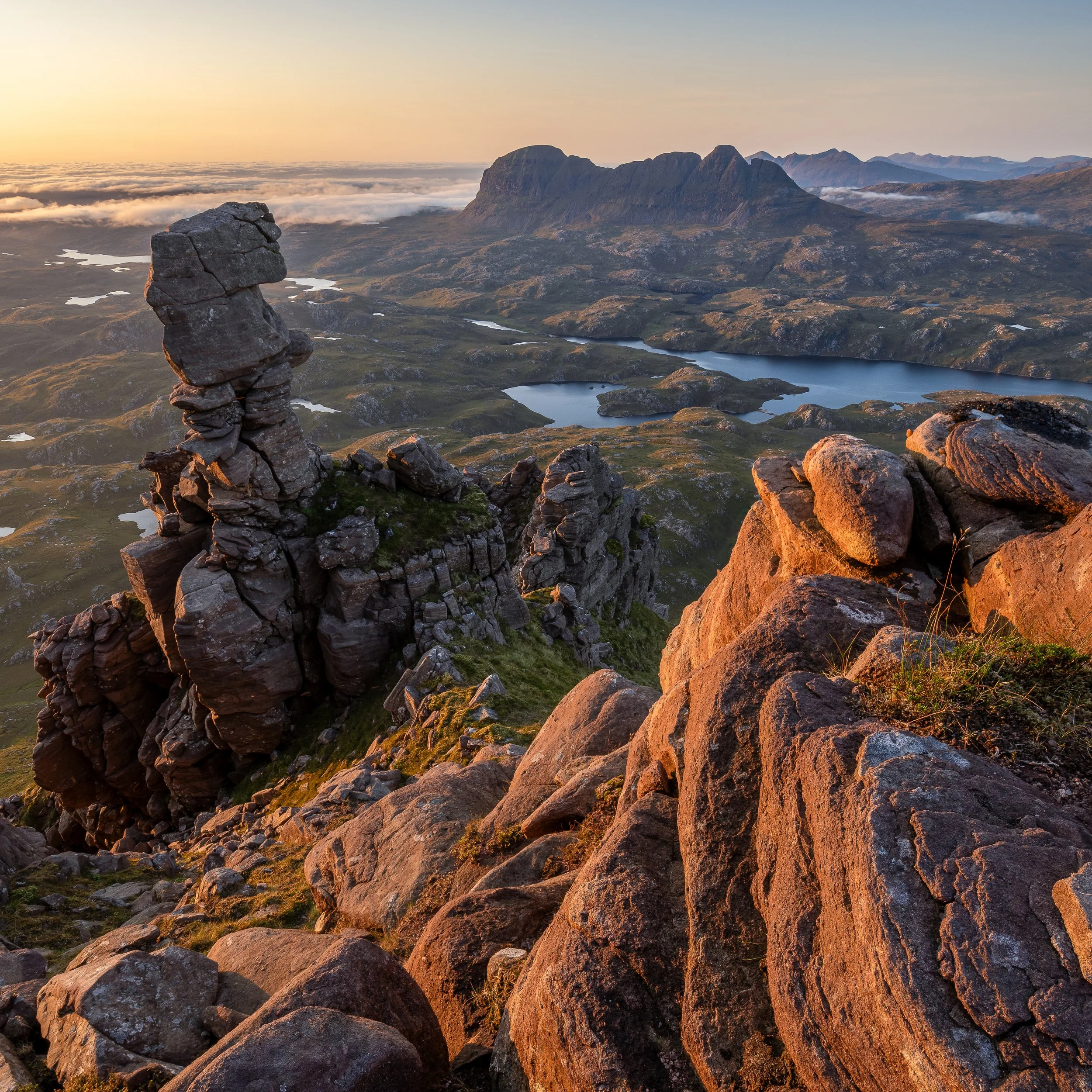
Summer - Suilven from Cul Mòr
Warning - please note that the specific location here is in a difficult to reach and remote part of the mountain, requiring some scrambling on steep ground. Do not attempt if you are at all unsure of your ability on such terrain.
Summer (June-August)
Summer offers a bigger window for shooting due to the long daylight hours, however this does come with the hinderance of some very unsociable timings for sunrises and sunsets! Arguably true darkness does not descend on Assynt & Coigach in the absolute height of summer. There is also the ongoing battle against midges and (increasingly) ticks to contend with. Nevertheless, its still beautiful!
Pros:
Vibrant landscape: The hills turn a to a deep and lush shade of green; there are also lovely wildflowers on the coastline and on the hills.
Long daylight hours: Gives you plenty of time to scout the location for optimal compositions
Northerly light: Sunset and sunrise light that hits the northern aspects of the mountains is a short window
Cons:
Midge crisis: Relatively unavoidable most days, usually around sunrise and sunset (annoyingly for us!). You’re actually hoping for a sustained wind (15-20mph is ideal) which will keep them at bay.
Harsh light: Although the midges shy away from the harsh sunlight, it does make for challenging photographic conditions if there is a lack of clouds to bring any tonal contrast to the landscapes. Atmospheric haze can also often scupper the most vibrant light at sunset and sunrise.
Sleep deprivation: Sunrise before 4am and sunset after 10pm. You will need some siestas!
Tourists: Many visit in the summer months. The hills, beaches, roads and campsites are far busier!
Light Direction & Subjects:
Light: Mid-July, as an example, the sun rises far to the northeast sets far to the northwest.
Subjects: Only time of the year that the northern aspects of the hills will receive sunset or sunrise light. Northern corries of Quinag; north aspect of Cul Mòr and Suilven etc.
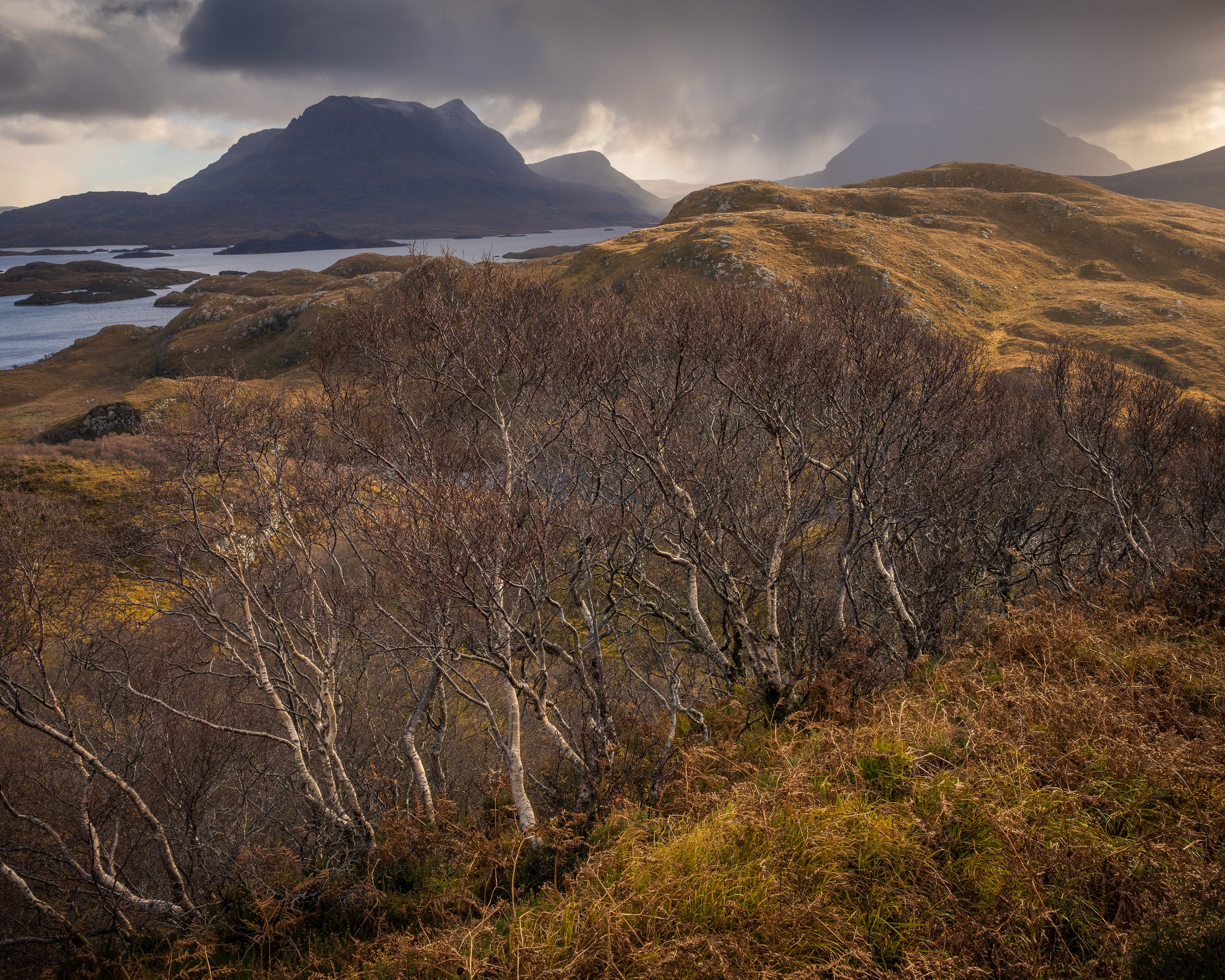
Autumn - Cul Mòr (left) and Cul Beag (right) from an unnamed cnoc near Lochinver
Autumn (October - Early November)
Autumn brings a massive explosion of colour and vibrancy to Assynt & Coigach. Although there are nowhere near as many trees as we would like as photographers, there are patches of native silver birch and rowans that make for excellent autumnal photographic subjects. There are also often fast-shifting weather systems that bring changeable and dynamic lighting and cloud coverage for those moody and atmospheric images that we are all drawn to.
Pros:
Rich Colour: The hills now change colour to a diverse array of spectacular colours: rusty oranges, coppers, deep browns and glorious golds as the grasses and bracken dies back.
Dynamic Lighting: Frequent weather systems bring ever-changing and dramatic light; heavy and broken clouds and the odd rainbow too!
More Civilised Hours: Sunset and sunrise moves to more respectable time, allowing for some more rest in-between shoots.
Cons:
Deer Stalking: Active patrols of stalkers mean that you must be extremely careful when wandering off-path to find unique compositions. I suggest wearing something bright if you do and inform the estate owners of your intentions before leaving.
Bad Weather: As good as the stormy weather can be at times for us photographically, sometimes this can turn really turbulent. Severe-gale and storm-force winds can frequent Assynt & Coigach. With nothing between you and the open Atlantic, this can leave you quite exposed, even if you aren’t out taking photographs and trying to hunker down in a tent or campervan.
Light Direction & Subjects:
Light: the sun returns to a due east and due west direction at sunrise and sunset, respectively.
Subjects: The western aspects of the hills receive beautiful raking light during the afternoon and into the hours before sunset. Cul Mòr and Cul Beag from the Lochinver side are attractive options.
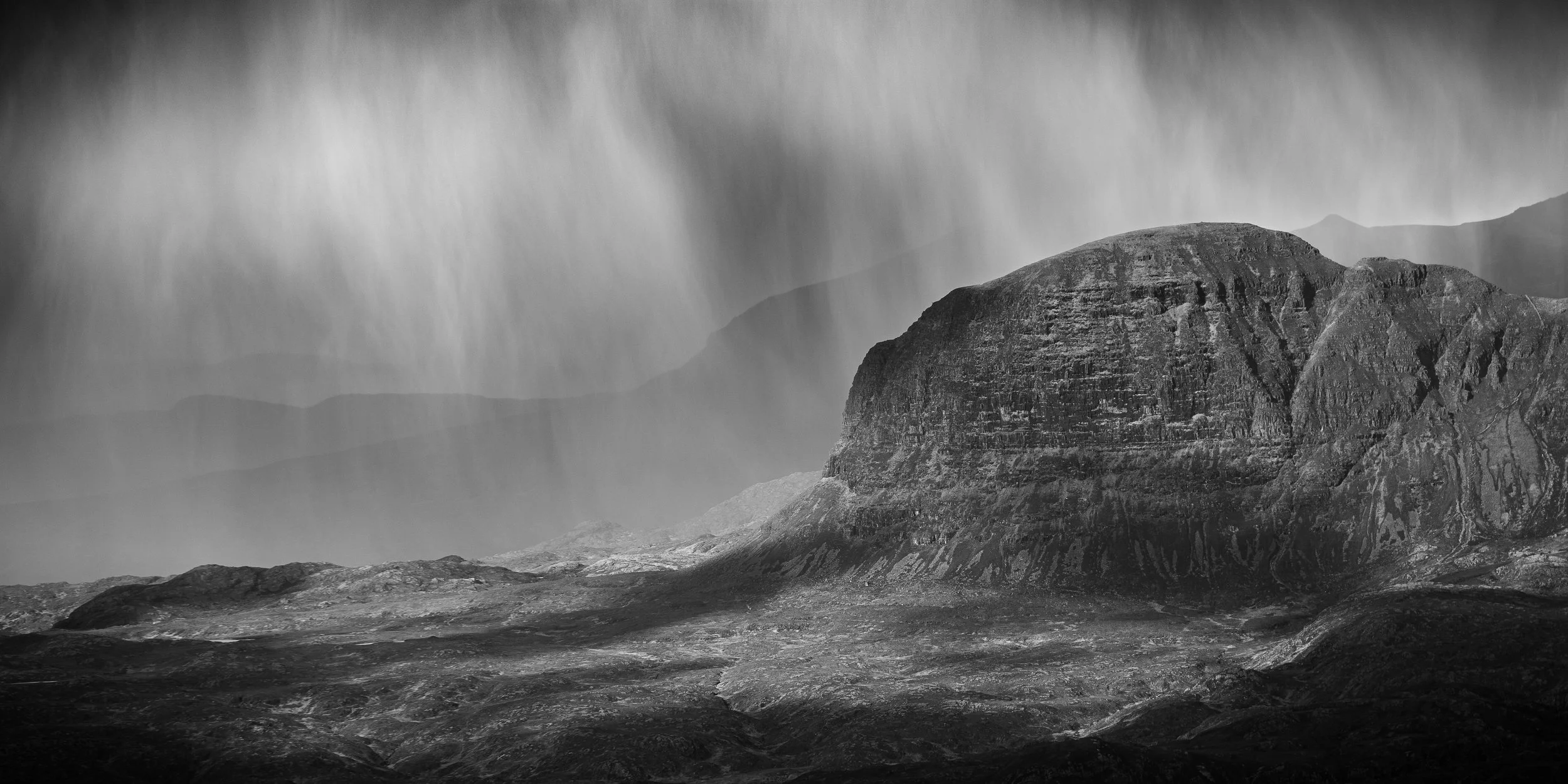
Winter - hailstorm falling over Suilven
Winter (Late November - March)
Regrettably for me, I have yet to experience Assynt & Coigach in a complete dousing of fresh powdery snow, despite a few attempts. This is not simply bad luck - as persistent snow to low elevations is relative rarity in this part of the Highlands. North Atlantic airflow means that temperatures stay relatively mild, therefore often precipitation at lower elevations falls as sleet or rain, melting away any snow that has fallen at glen level. Although the ‘blanket snow’ conditions may be difficult to come by, there is often snow on the high terrain. Winter conditions on the mountains in Scotland provides some of the most incredible opportunities for photography that you are likely to experience anywhere! However, hillwalking in winter in Scotland does carry inherent risks. See my Guide to Winter Mountain Photography article for advice on how to stay safe.
Pros:
Ideal Lighting: Due to the low angle of the sun throughout the day, it provides perpetual ‘good lighting’ conditions (provided it’s not hidden by cloud!)
Artic Transformation: When doused in snow, the hills become even more beautiful in my humble opinion! The textures that can be found in snow also provide some incredible opportunities for both foreground interest and also intimate scenes. Look for sastrugi patterns (wind blown snow) and rime ice that are particularly aesthetic.
Astrophotography: The completely dark, unpolluted night skies are ideal for photographing the Milky Way or Aurora, particularly given how far north you are in Assynt & Coigach, Use bodies of water to reflect the aurora (e.g. Loch Lurgainn - easily accessible and Stac Pollaidh as an additional subject).
Cons:
Short Daylight Hours: Less opportunity to perfect compositions or move between multiple locations. If the weather turns there is also less time for it to shift in time for sunset.
Dangerous Logistics: Winter hillwalking experience is absolutely essential on the mountains here under winter conditions. Steep aspects and large crags present obstacles and increase avalanche risk in specific conditions. Specific mountaineering equipment will also be required: micro spikes, crampons, crampon compatible boots, additional warm layers, ice axe and more. Access via the roads also becomes a significant barrier, as many of the minor roads are not treated and may be more susceptible to freezing conditions.
Light Direction & Subjects:
Light: the sun rises in the south east and sets in the south west, remaining relatively low throughout the duration of the day.
Subjects: The southern aspects of the mountains shall receive good light throughout the day. However, the northern aspects may present more wintery conditions. Unfortunately these aspects are mostly very remote and under heavy snowfall would be near impossible to reach unless you are very willing to wade through snow for days. Northern corries of Quinag would be a good alternative option though.
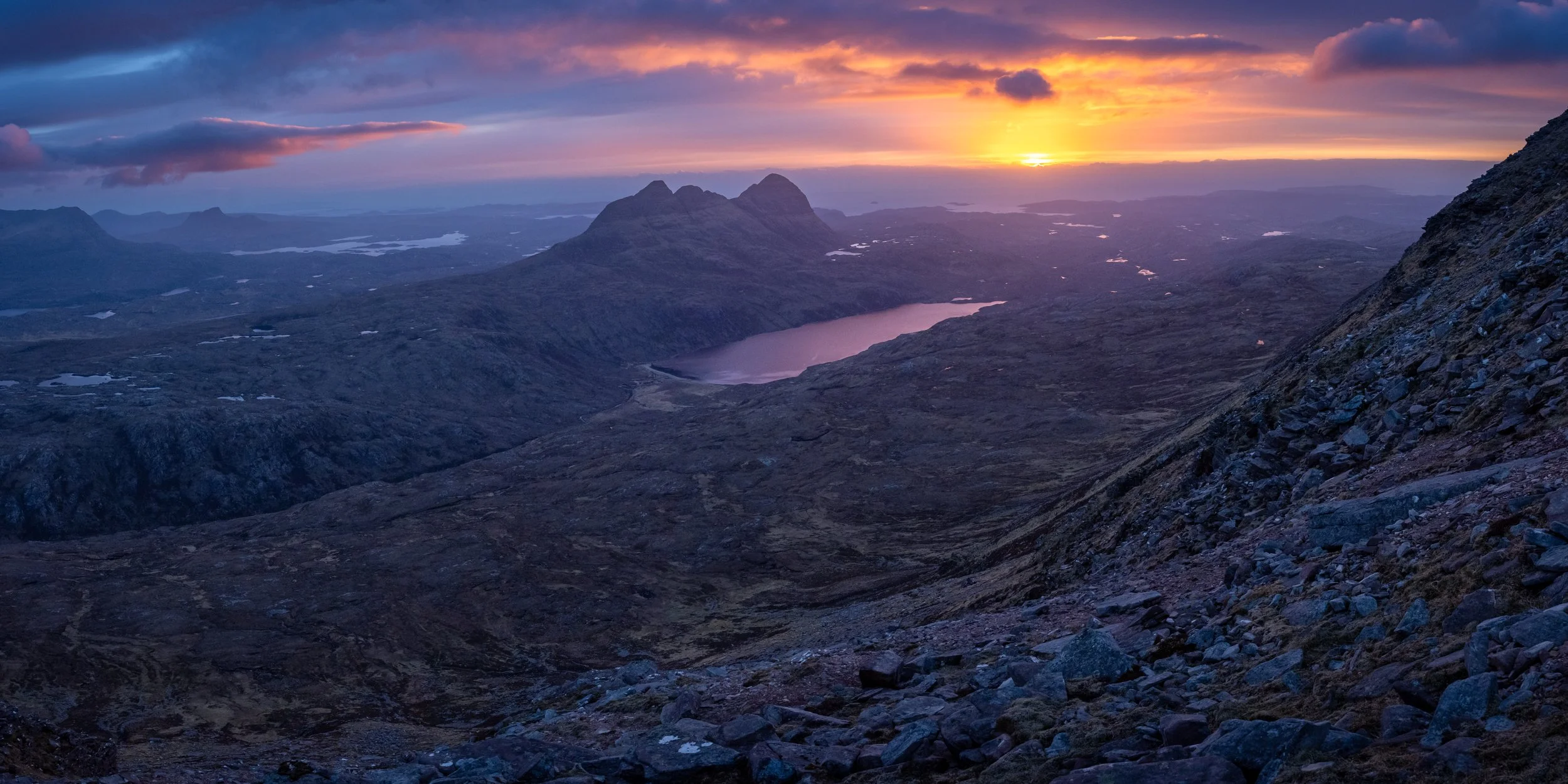
THE Icon of Assynt? Suilven is an ever-present as you journey around the area.
Best Locations for Photography in Assynt & Coigach
One of the greatest attractions for photographers to Assynt & Coigach is the diversity of the landscape and photographic opportunities within a relatively compact geographical area. The isolated sandstone mountains are the clear highlight of the region, their aura and majesty are undeniable and one or more of them will feature in almost all of your grand scenic images here. However, the winding sea lochs, the cnoc and lochan landscape and the pristine beaches mean there are no shortage of alternative subjects to explore.
The locations and subjects that I have listed below represent some of the most rewarding, providing a strong introduction to the area whilst also leaving plenty of scope for your own exploration and discovery. Part of the magic of Assynt & Coigach is uncovered when you find those perspectives and subsequent compositions that are uniquely your own.
1) Suilven
One cannot simply write a guide (of any kind, photography aside) about Assynt & Coigach without special mention to what I would consider to be the icon of the region, bar none - Suilven. The mountain has an alluring quality that draws your attention over and over and over again. As you travel around the roads and hike along the various trails, you’ll discover new perspectives of the mountain, and one of the most intriguing characteristics of the mountain is how it manages to look uniquely different, yet always familiar, from various angles.
For the purpose of this guide, I’ve decided to acknowledge Suilven as a photographic subject rather than a location to visit (although I do detail this as well) giving specific reference to some of the best places to photograph the mountain from.
Suilven from Loch Druim Suardalain
Access: Easy access from the car park at the end of the single track road towards Glencanisp Lodge from Lochinver. Short walk to the loch side from the car park.
Highlights: Suilven’s western aspect provided the derivative for its name (Sùla - “soo-la”, Old Norse, meaning ‘pillar’; Bheinn - “ven”, Scottish Gaelic, meaning ‘mountain’) whereby it resembles a slender pillar of rock. The reeds in the loch and the isolated Scot Pine trees combine to make a beautiful scene here.
Ideal conditions: Any time of year works. Winter is still relatively accessible and can provide interesting foreground patterns in the loch; whereas summertime sunsets will mean that the north and western aspects of Suilven shall be lit by the light (beware the midges though!) If you’re lucky, reflections really help here.
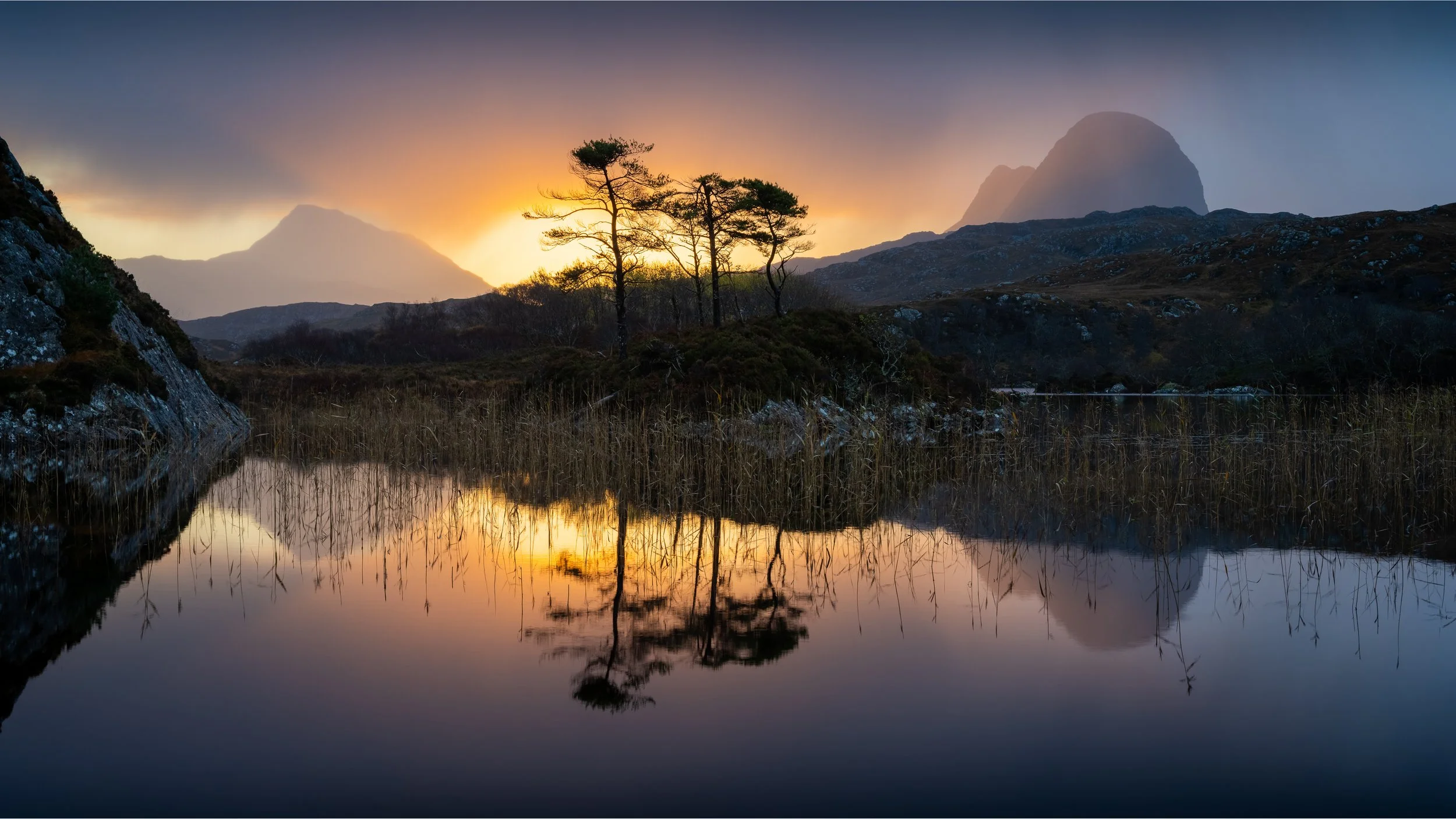
Compositional ideas: Use the reeds as foreground elements and try to frame Canisp and Suilven using the Scot Pines. This is a very popular location, and rightly so, but there are unique takes to be found here if you are willing to hunt around and be experimental with your composition.
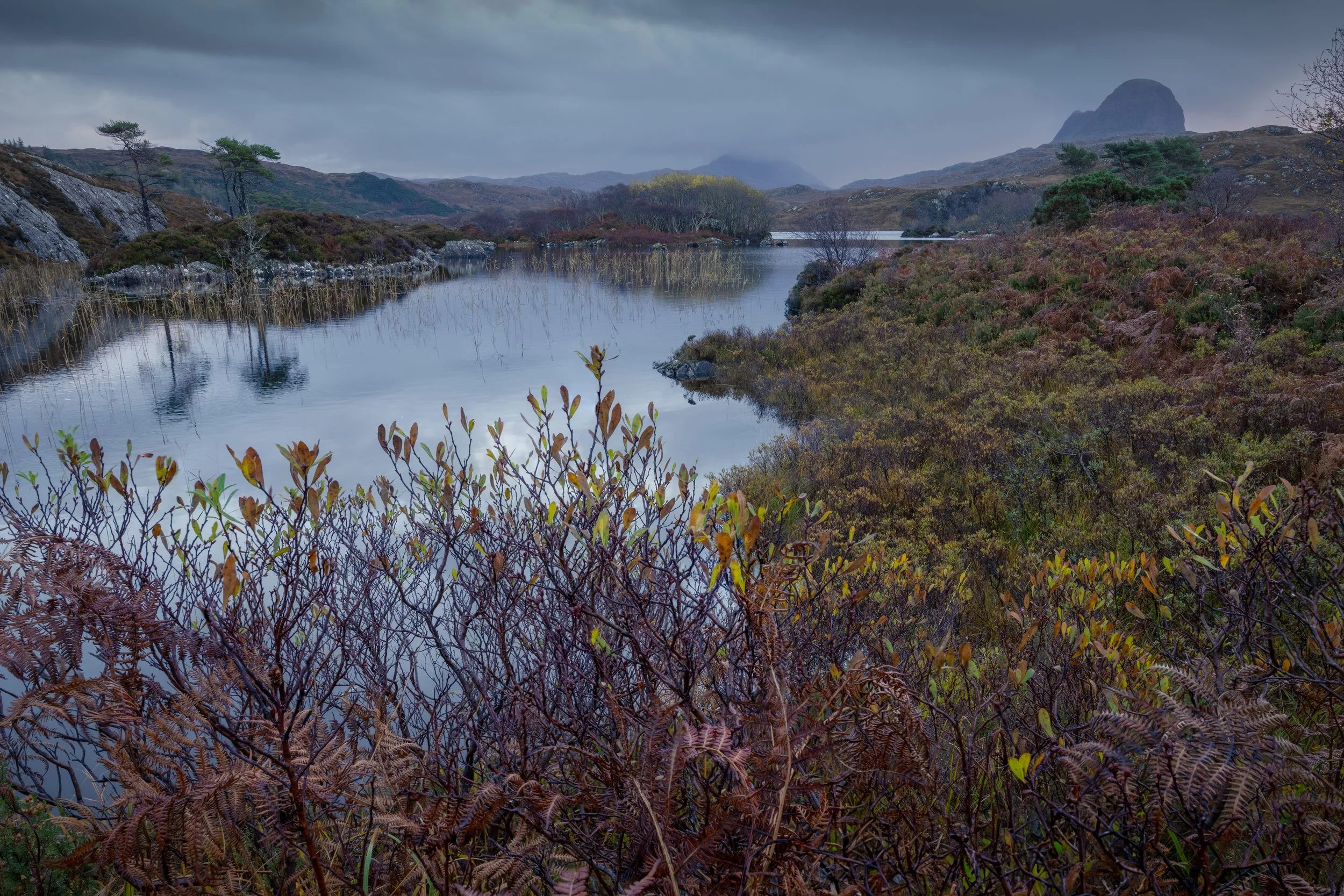
Searching for alternative compositions at Loch Druim Suardalain
Suilven from Canisp
Access: Committed hike on pathless terrain up the rugged and rocky mountain, Canisp. Hill-walking experience is essential and will require good navigational skills if attempting to be there for sunset or sunrise. Photographers may consider a summit camp to make the most of both sunset and sunrise opportunities.
Highlights: The view of Suilven from Canisp is particularly interesting because this aspect of the hill is only visible from this location. Canisp itself and its subsidiary ridges block any views of Suilven from the north and north east from lower elevations and the shape of the mountain shifts as the eastern peak, Meall Meadhonach, becomes the main focal point - resembling a shark fin.
Ideal conditions: Again, any time of year would work well here. Although in the winter months when the sun will be setting behind Suilven in the southwest, some snow cover on the foreground and on Suilven would be preferable. Summer months would allow for a sunset where you are not necessarily shooting directly into the light at sunset. However, as you can see from one of my example images taken in April, the distant sun across the open Ocean can provide a nice additional subject.
Compositional ideas: There is a myriad of sandstone and quartize boulders to use as a foreground element, but they can be quite messy here and therefore challenging to create something well-balanced. I would give yourself plenty of time to hunt around because the opportunities are frankly endless. Omitting the foreground here altogether also works well, isolating Suilven if there is some particularly interesting conditions or dramatic lighting.
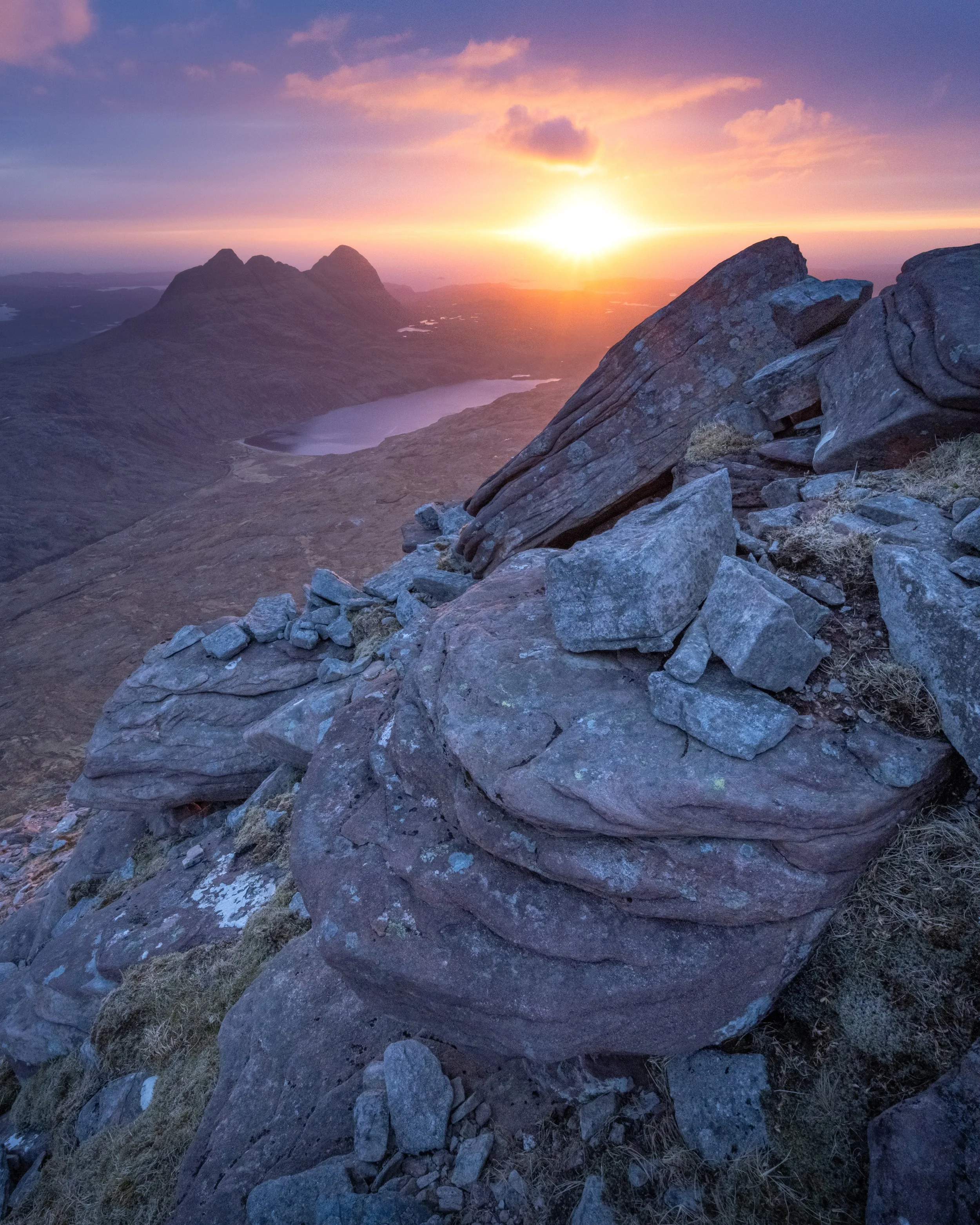
The most unlikely of sunsets.
A frantic search for a comp on Canisp as light pierced a bank of cloud on the horizon.
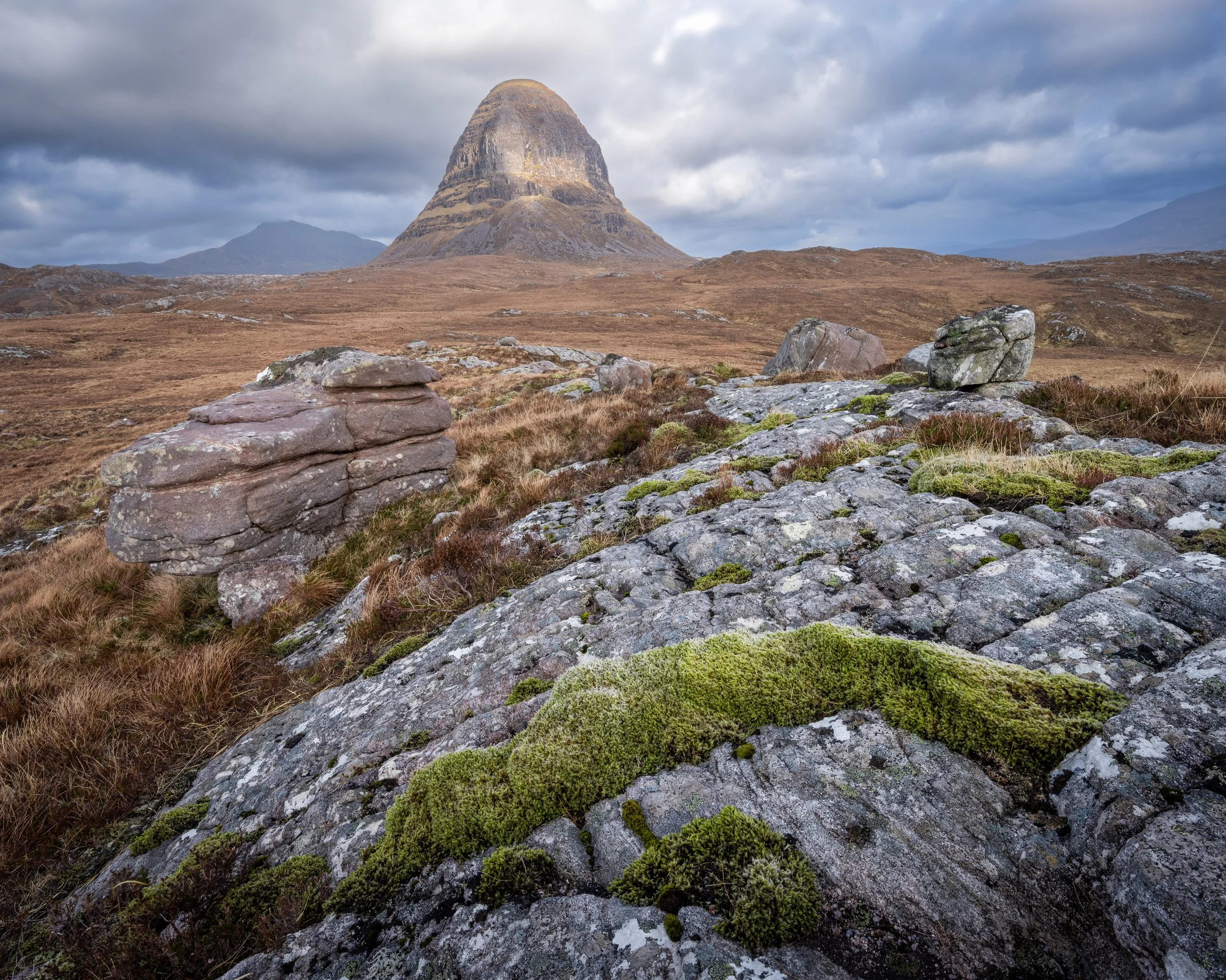
Up close and personal. The pathless wilderness around the base of the mountain has endless opportunities for images, but requires commitment.
Suilven’s Surroundings
Access: Good track from Glencanisp Lodge or stalkers path from Inverkirkaig can help you cover most of the ground towards the base of the mountain. Then off-piste exploration is required to find the best photographic opportunities as you draw closer to the mountain. The hike to the summit of Suilven is roughly 10km one way, so do be mindful of your return plan if staying for sunset. Combining a sunset, camp at the base of the mountain and a sunrise from the summit is a reasonable suggestion.
Highlights: You can align yourself so that the pyramidal profile of Suilven from the west can be really appreciated. At closer proximity, there are a series of lochans that can be utilised for strong foreground elements, particularly if you are fortunate to get some reflections. These perspectives are seldom photographed and will allow you to come away with some unique images.
Ideal conditions: Any time of year will work well here, although you may struggled in the late spring/early summer time when the sun sets directly to the west and will mean you have to contend with your own shadows when shooting wide angle scenes. Reaching these areas under a blanket of fresh snow would also be a considerable challenge due to the distance required to cover on pathless terrain - but the reward would be monumental! Sunset in the height of summertime or in the autumn months would be good to get sidelight across the scene.
Compositional ideas: As previously alluded to, the scope for unique compositions here is vast. It would take a long time to scour all of the available foregrounds and combinations with the mountain. There are a number of interesting isolated boulders to use, and the lochans close to Suilven are quite possibly the highlight from this area.
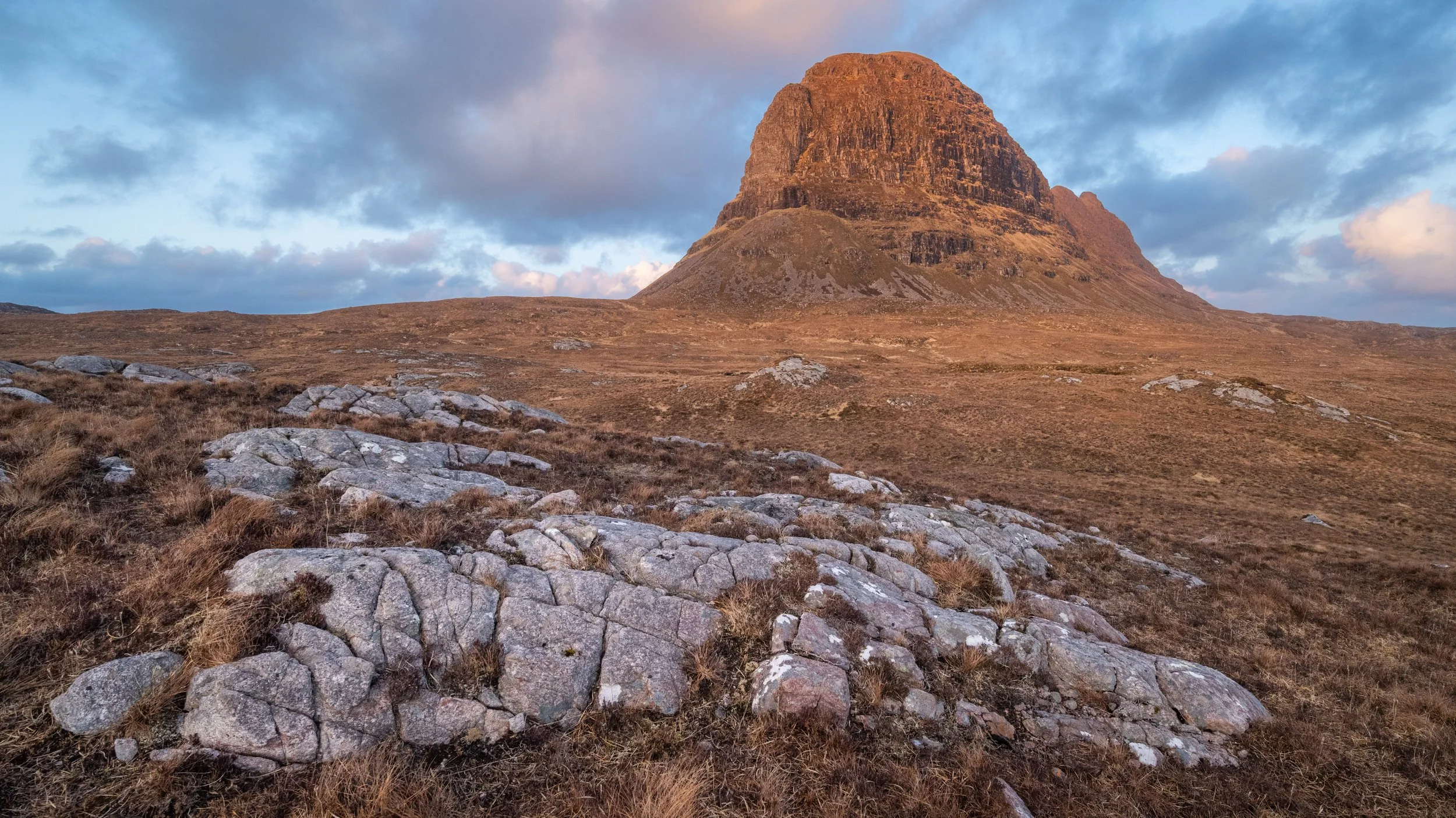
The last light of the day illuminates the impressive rim of crags on the southwest aspect.
Ascent of Suilven
Visiting the summit of Suilven is an experience that will stay with you forever. This is a special place to be and the long walk in only adds to this feeling. With that said, the remote and exposed nature of this location means that prior hillwalking experience is strongly advised to visit. To reach the summit from Glencanisp Lodge is approximately 10km one way, and this is the route I would recommend due to the good track that is now established pretty much to the base of the mountain.
A steep ascent to the bealach at the centre of the slender ridge follows but there is no real difficulties to be overcome with regards to scrambling. There is one minor section that may require a hand or two on rock shortly after you cross the wall (which itself is an extraordinary feat of ingenuity when you pause to reflect upon how difficult it must have been to build). There’s also a very short narrowing of the ridge where the top of two gullies on both the north and south sides of the mountain meet, which may cause some concern if it is especially windy. That being said, I’d strongly advise against an ascent in strong winds at all. Any route off the mountain other than the steep descents from the main bealach would be very consequential and extremely dangerous. The summit of Meall Meadhonach to the east requires some exposed scrambling, up to Grade 2/3, to reach the airy top.
An ascent of the mountain in winter conditions would require plenty of prior winter mountaineering experience. The steepness of the flanks on Suilven means that it would be prone to the formation of common avalanche problems and an ability to identify these risks both in your preparation and your in-person observations would be critical. To learn more about winter hillwalking, read my Guide to Photography in the Winter Mountains.
Despite all of the aforementioned considerations, the view from the ridge is a relative ‘classic’ for this region. Many photographers have made the ascent and (if timed just right with the weather) you’ll be sure to come away with an image or two that you’ll be proud of. I would advise arranging to camp either on the ridge or at the base of the mountain to give you the opportunity to photograph sunset and sunrise.
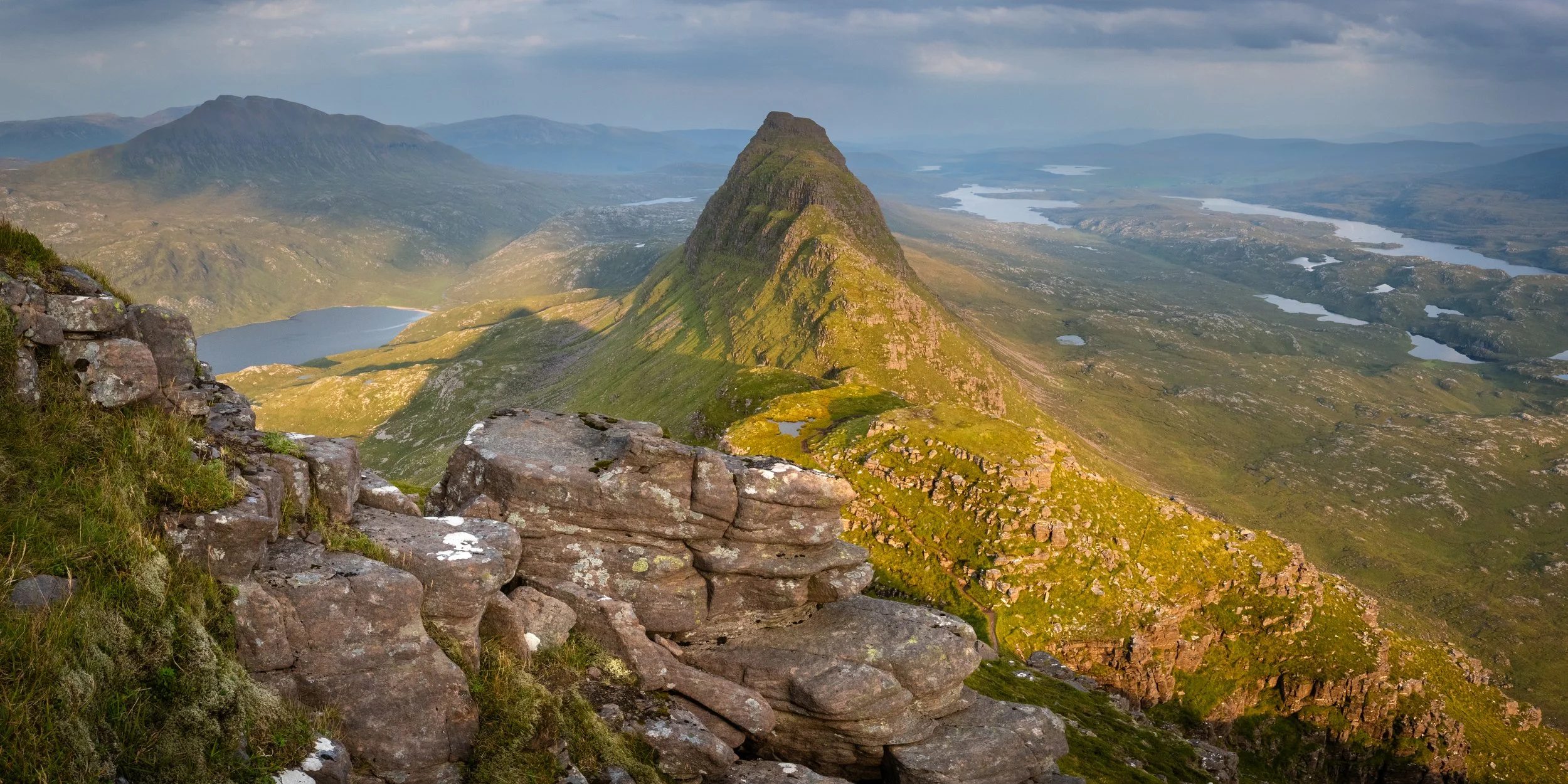
The ominous sound of thunder rumbled very loudly from nearby just seconds after I took this image on Suilven.
A few moments later I saw the next flash of lightning just off the sea near Lochinver. Safe to say I took no more images that day!
2) Stac Pollaidh
Second only to Suilven in the award for ‘most recognisable profile’ has to be Stac Pollaidh, This is the smallest of the hills in the Assynt & Coigach area, but perhaps the most dangerous. Scaling the narrow crest of the summit ridge requires very careful footing, good scrambling ability and a head for heights. The unique pinnacles that adorn the upper flanks of the hill make for excellent photographic subjects, with the other mountains of Assynt to the north and Coigach to the south providing the perfect backdrops.
An ascent must be carefully planned, including possible escape routes off the mountain - particularly if you are hoping to stay for a sunset or ascend for a sunrise.
Below the Stac
There are interesting perspectives looking up to Stac Pollaidh from all aspects on the ground immediately below the hill. From here, you can emphasise the twisted and gnarled shape. Foregrounds are scarce on the southern slopes, with only the occasional boulder and most of them are individuals that look a little contrived when placed alone in front of the mountain. If you are willing to venture off the path onto pathless ground to the northwest of the mountain, then there are far more opportunities for foregrounds here, but the most interesting outline of Stac Pollaidh is now lost. In the right conditions though, there’s no need to actually ascend at all. This area is suited to overcast conditions too - the grotesque and spooky outline of Polly can create some really ominous and dramatic scenes.
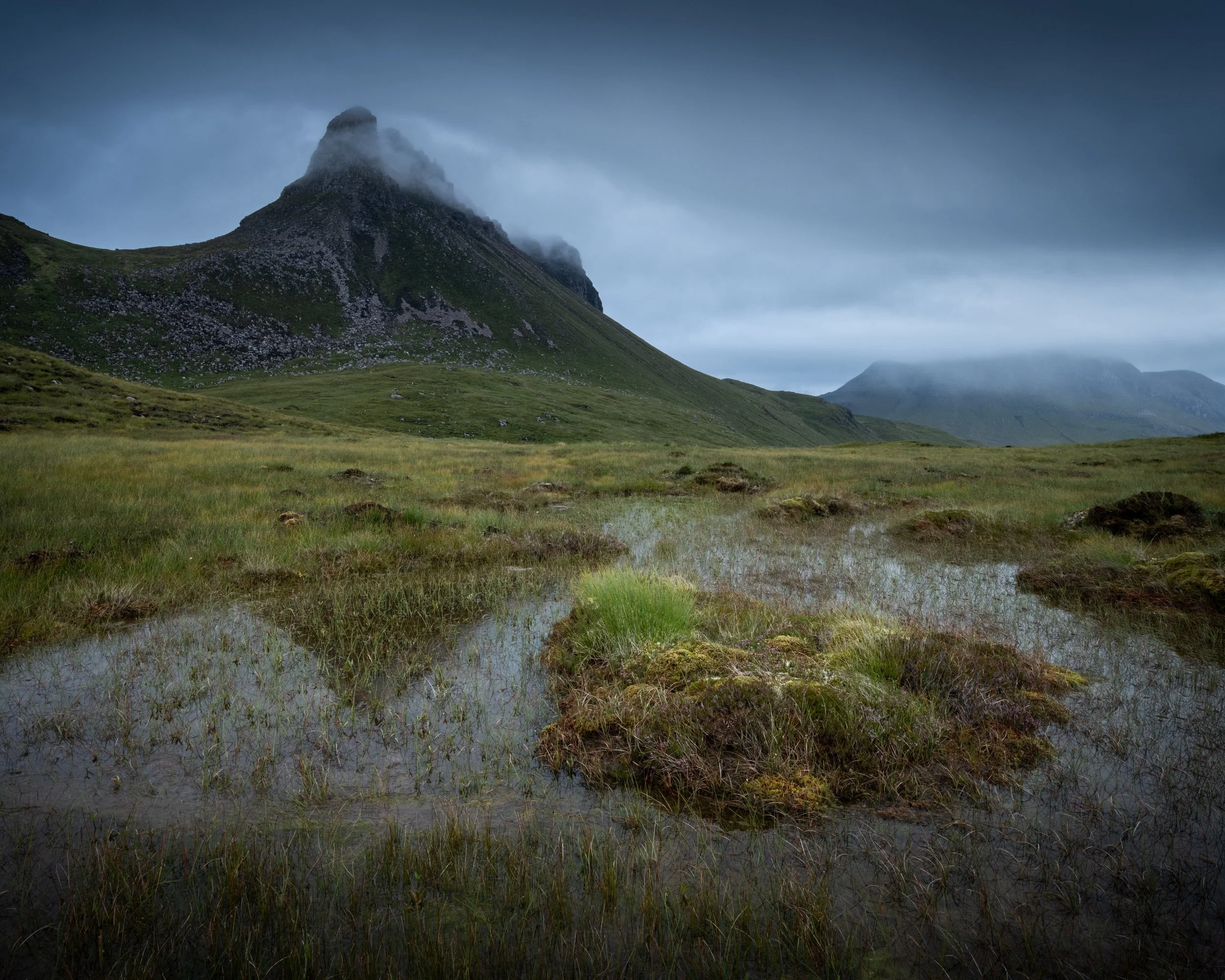
Ominous - low cloud swirls around the pinnacles of Stac Pollaidh.
Polly’s height means it’s summit is often cloud free, even when the others nearby are capped.
Out the back door
The conventional way to ascend Stac Pollaidh is to take the clearly defined path that circles around the hill on its east aspect. As you round the corner and reach the crest of a rise, the views open up (and the heart soars!) Suilven and Cul Mòr really look beautiful from here, with Loch Sionascaig and Loch An Doire Dhuibh barricading them from the south. They appear as two impenetrable castles perched above a giant moat. From here, it’s quite acceptable to ignore and possible foregrounds all together and wait for the right light to dance across this scene and work a sweeping pano. Unfortunately I’ve never quite had the kind of light or conditions I would like for this scene. This expanse is pretty remote and pathless beyond the one you are stood on, I think it would suit a winter coat very well - just to increase the feeling of desolation! I also think this is the perfect location to visit on a changeable day of sunshine and showers - with the view directly north you would be quite likely to see some rainbows at some point!
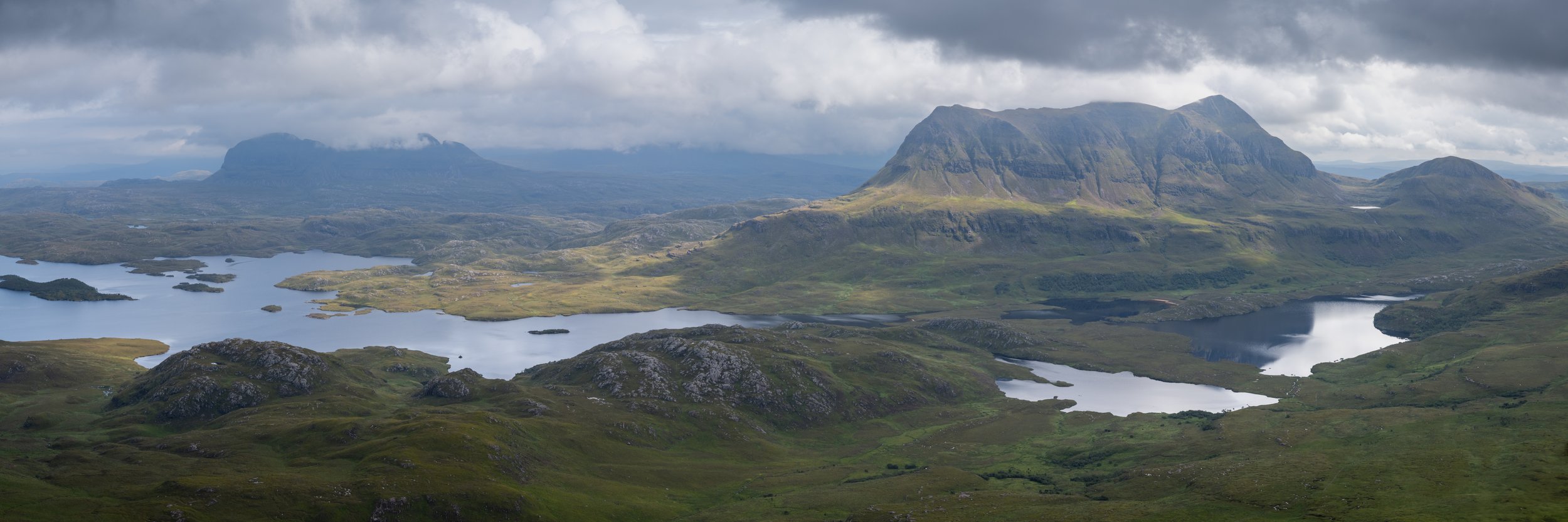
Panoramic views - literally! On the approach to the crest, the view north across Assynt opens up, with Suilven and Cul Mòr now captivating the attention… For now.
The Crest
The main path ascends to the lowest point on the crest of the ridge, towards the eastern top, from here you can explore to your hearts content. Be aware though, that progress along the ridge is awkward and you may end up following the narrow path the contour across the south side of the crest whilst seeking an easier line of approach onto the top of the ridge itself. Progress to the very western end is barred by an unavoidable pinnacle that does require a couple of awkward moves over exposed ground to traverse across it - it’s also important to note that this must be re-ascended on the return.
That being said, there are more than enough interesting compositions to satisfy the photographer without having to assail the worst of the hurdles. Look out for the crazy spires in the gullies on the south side! There are several characterful rock structures to use as a subject, many you will have seen photographs of before if you have done any research of photography from this area before!
A sunset here at any time of year would be ideal - with the wide expanse to the north and no obstructions to the coastline, raking sidelight is almost guaranteed if the conditions are in your favour. Try to compose your wide angle images from here with an equal proportion of foreground to the background. The large lochs previously mentioned provide a perfect mid-ground to the distant mountains too, so be careful not to obstruct them with your foregrounds too much.
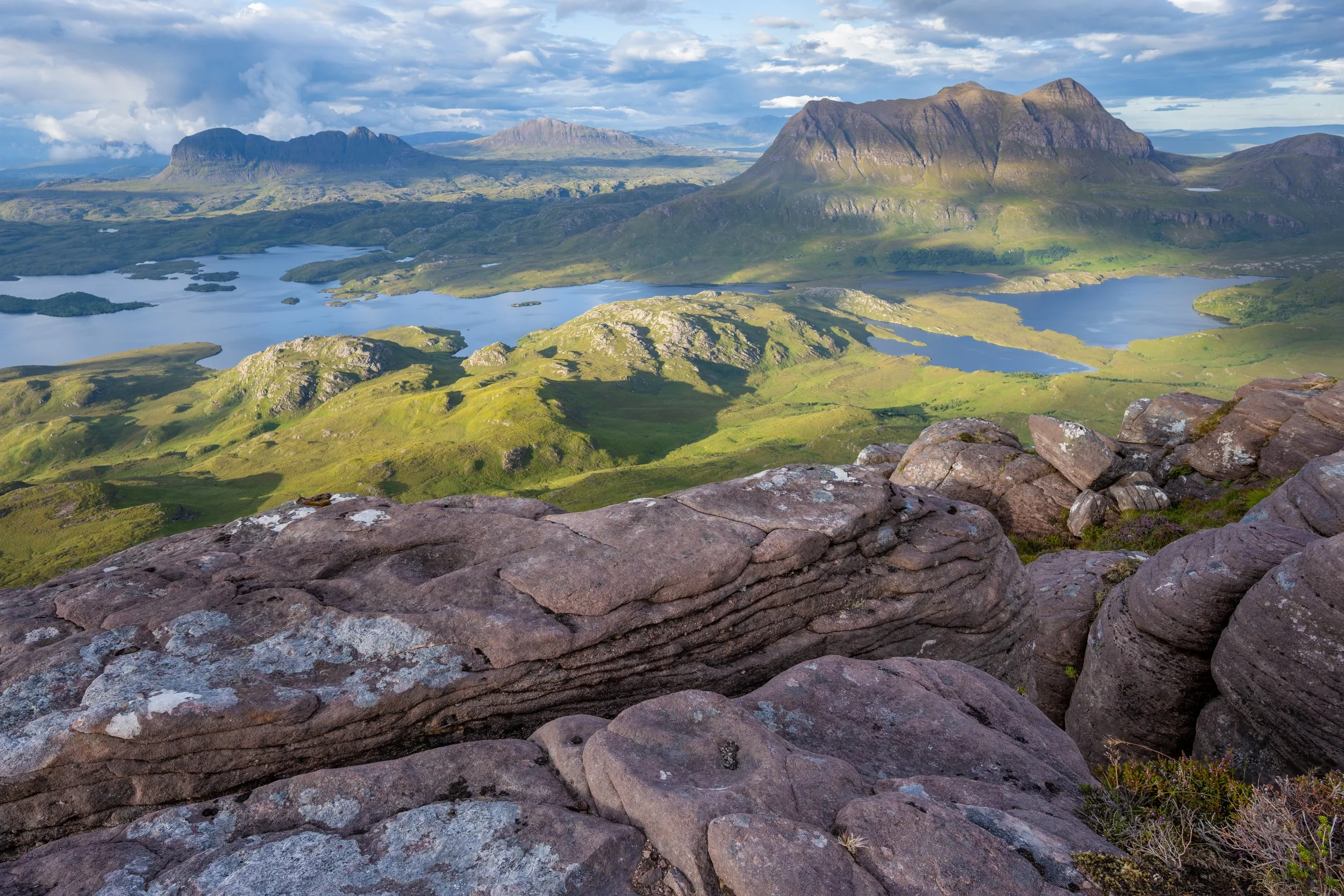
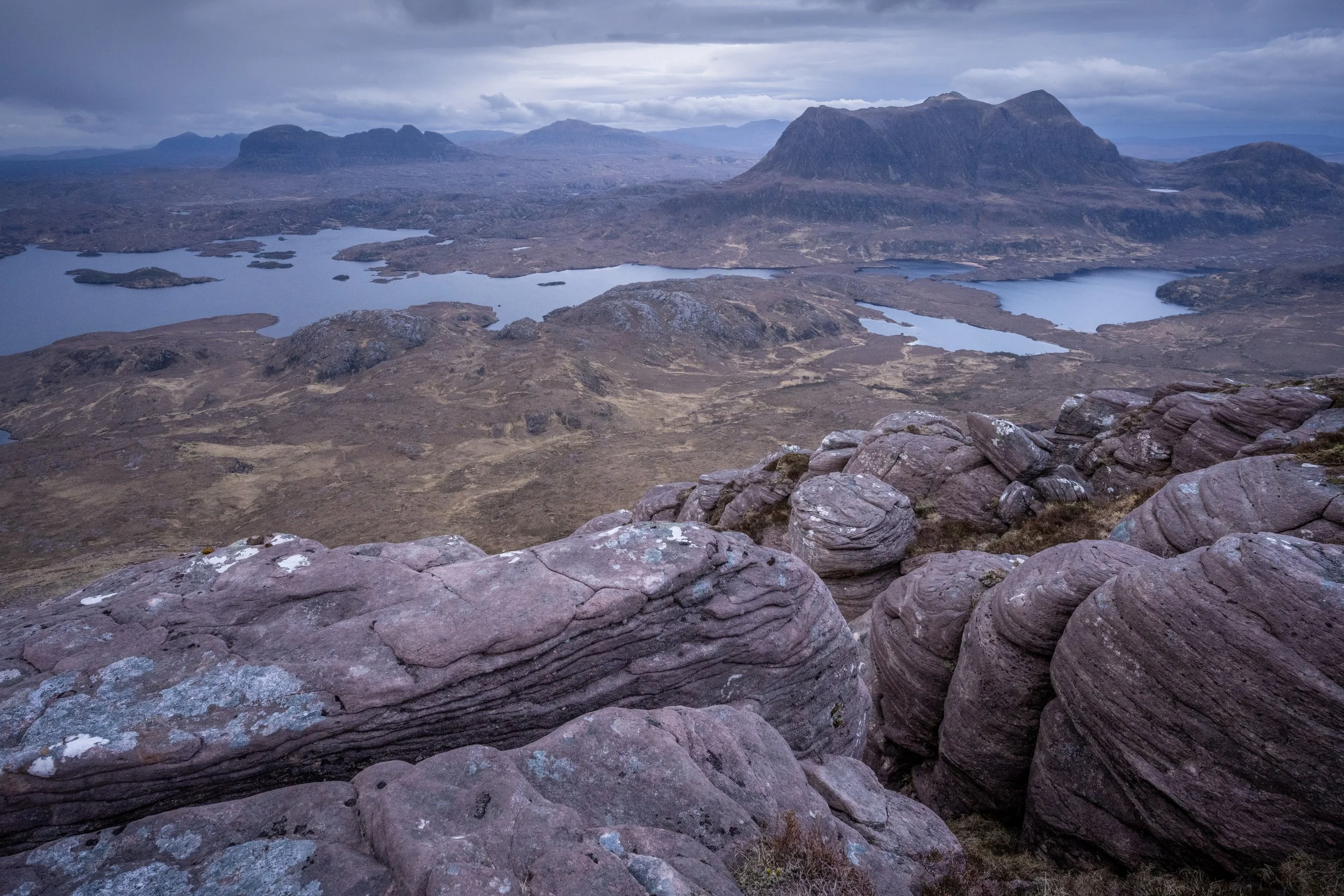
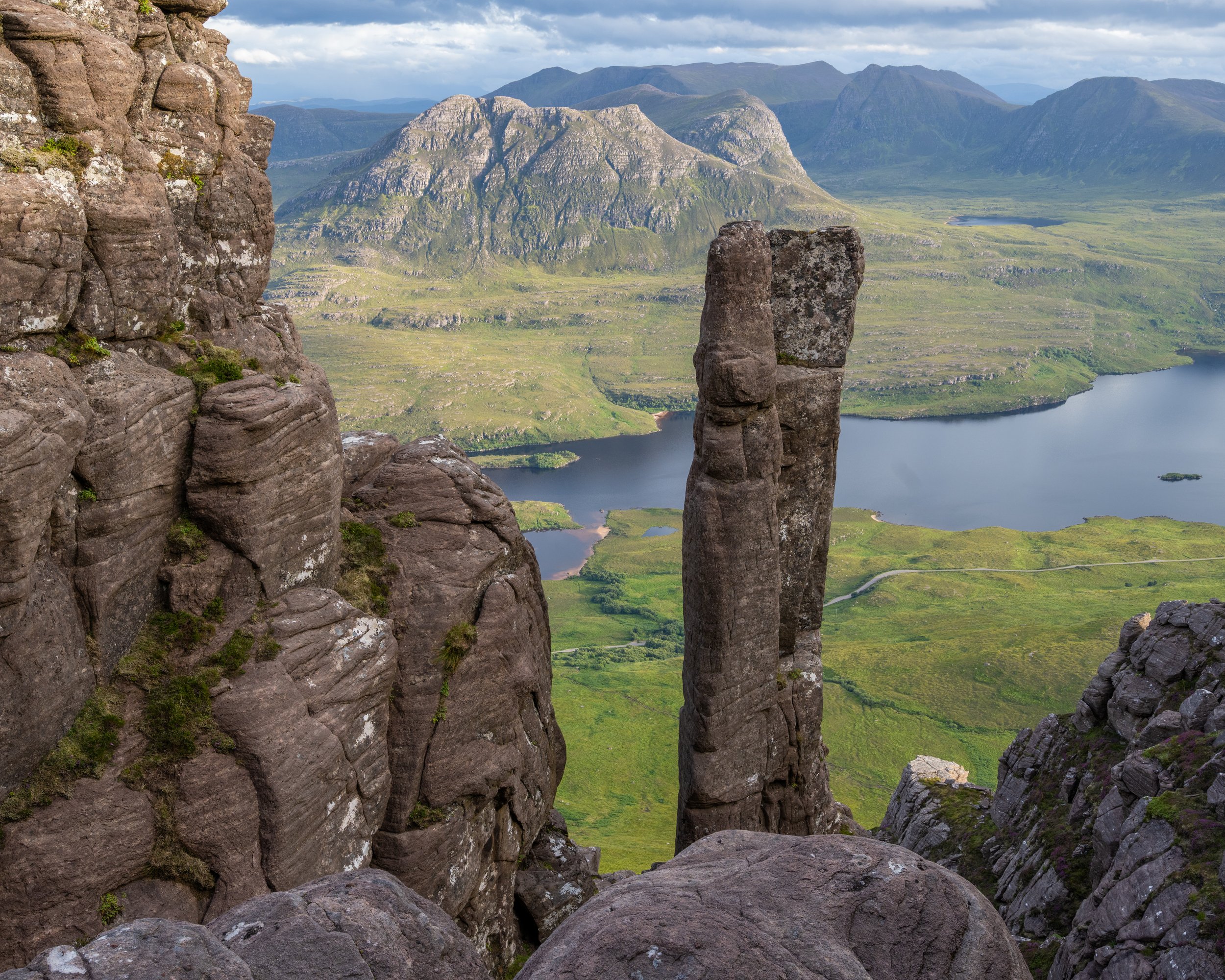
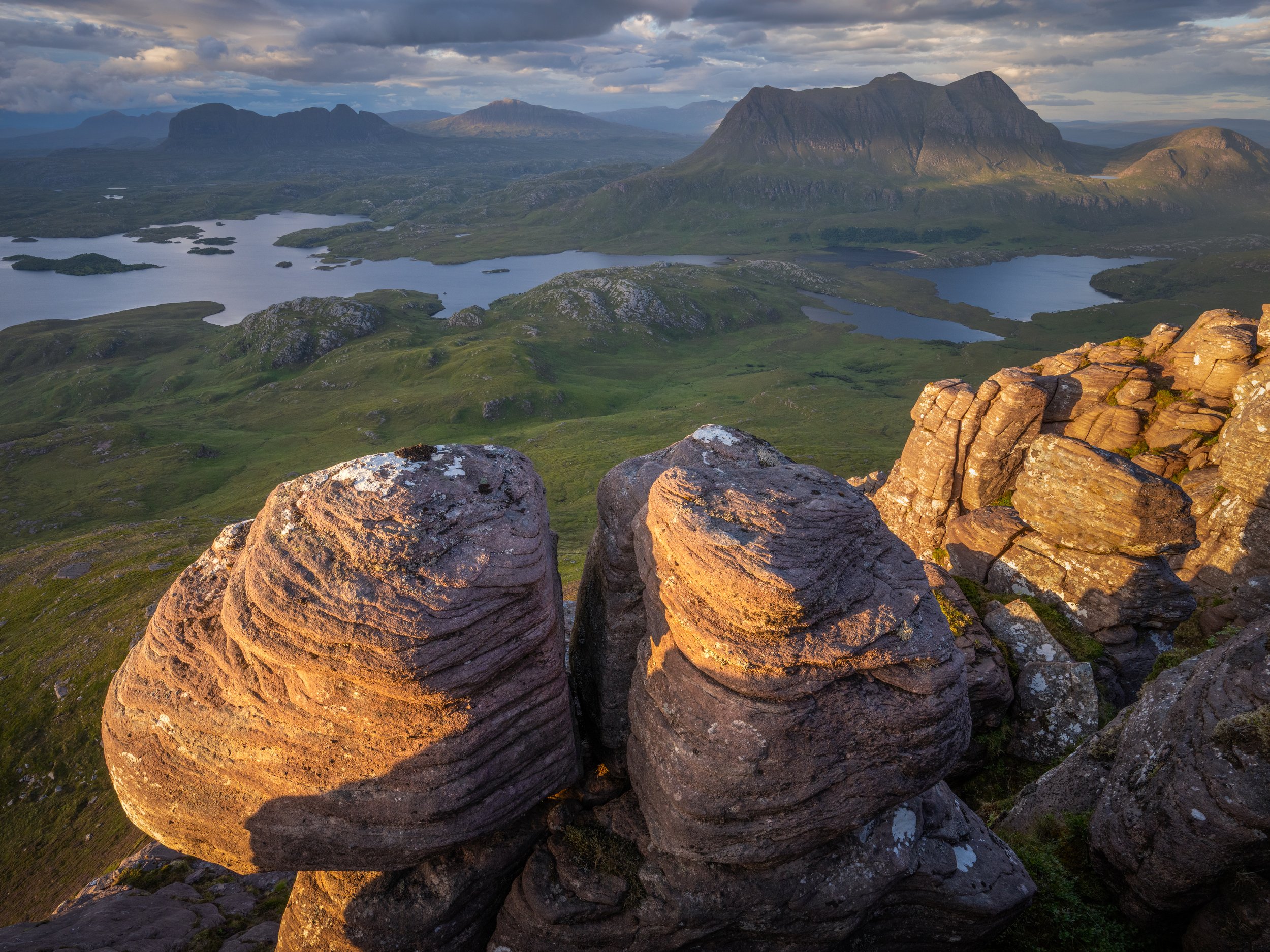
Examples from the ridge - endless options to go at!
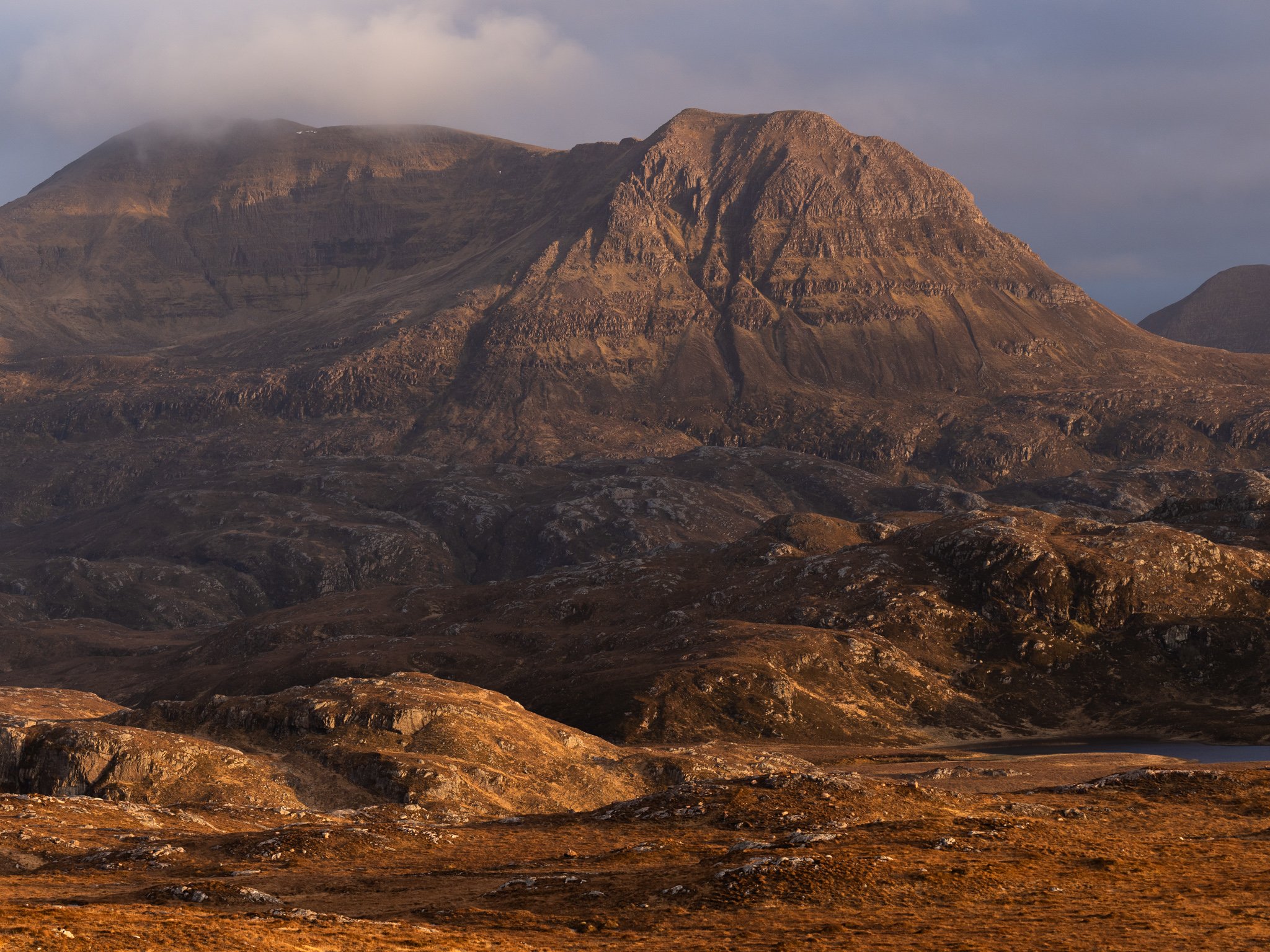
Grandiose - Cul Mòr is the largest of the mountains in Assynt and Coigach and boasts an impressive and photogenic profile.
3) Cul Mòr
The views here are superlative. In a region boasting the vistas from mountain summits such as Sgùrr an Fhìdhleir, Suilven and Stac Pollaidh (which are all astonishing in their own right) it would take something really quite exceptional to come out trumps – and that is exactly what Cul Mòr does. Fortunately, the mountain is relatively accessible, albeit a longer walk than two of the aforementioned, but there are no real difficulties in the ascent. The perspectives both north and south from the wide summit area are just unbelievable. This is easily my favourite mountain in the area for views and one that is worth visiting on multiple occasions at different times of year to really do justice to.
As with all of the other mountain ascents mentioned in this guide, Cul Mòr requires careful planning and consideration. I’ve noticed that this mountain tends to attract the cloud more than its counterparts, which makes sense seen as it is the highest of the hills in Assynt and Coigach, and despite being a relatively easy ascent there is an awkward boulder field to contend with and it does have a remote feel on the summit.
The views north
During the conventional route of ascent, any indication of the spectacular views from the summit are completely obscured until you reach the crest of the Cadha nan Each ridge on the northeast side of Cul Mòr. From here, the views only improve with every step you take. There are opportunities here to find some interesting foregrounds to pair with the backdrop of Suilven, but if I’m honest the best is ahead and it’s as well to press on so you can make the most of the many options on the broad summit.
The view to the north is simply astonishing. Suilven rises proudly from the lochan-laiden landscape below, and in my opinion this is the best view of its beautiful profile in the region. The support acts help - Quinag and Canisp are also clearly seen and together they form a spectacular backdrop for any composition you may find along the escarpment.
There are endless foreground options to choose from. The most well-known area is a fantastic sandstone rock garden just to the west of the main summit itself, albeit it is harder to be truly unique compositionally from this particular spot. Nevertheless, the peculiar sandstone arrangements here are so characterful and simply cannot be ignored! I’d highly advise shooting here at sunset in summer when the foregrounds will receive sidelight.
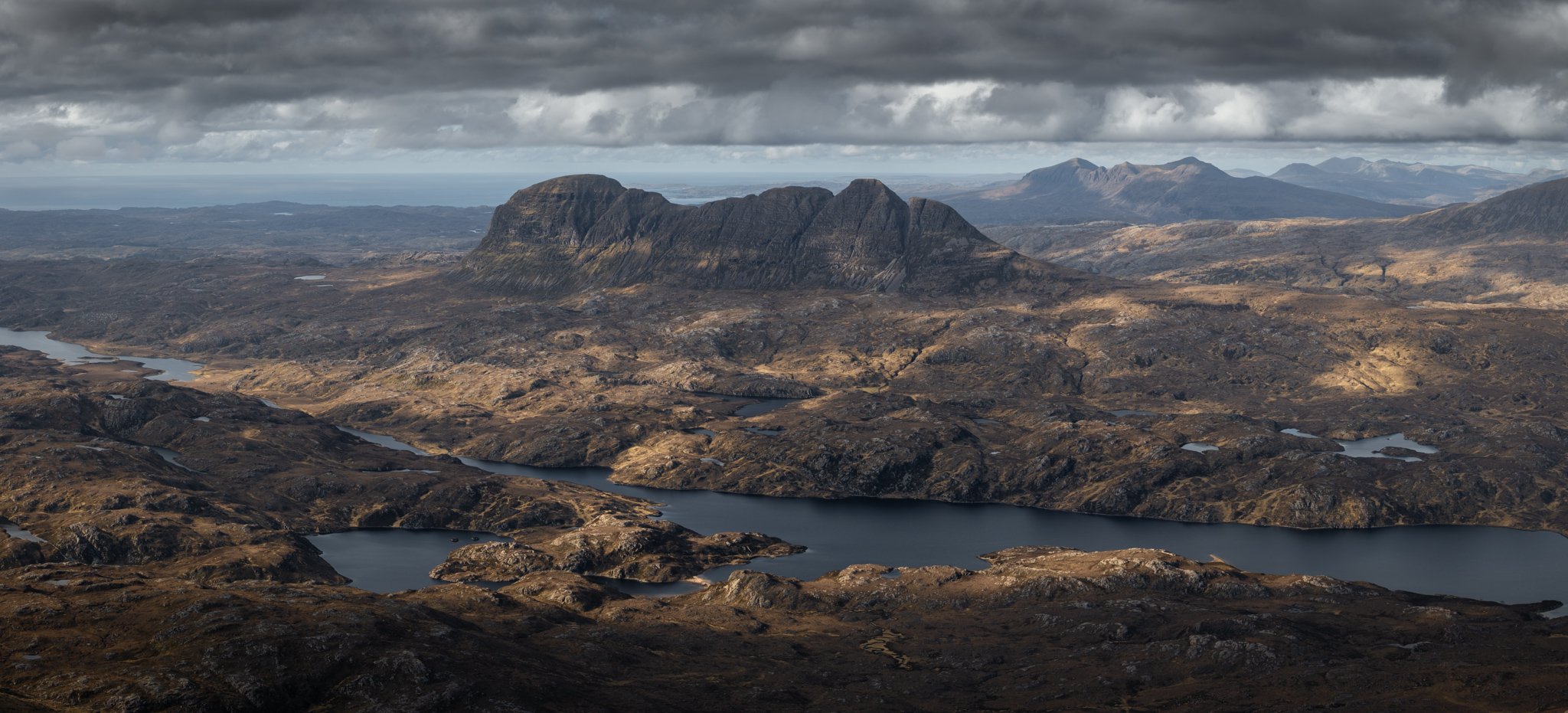
Astonishing – the superb view to the north from the summit of Cul Mòr. Suilven is prominent, Quinag in the background and even the distant Ben Stack and Foinaven.
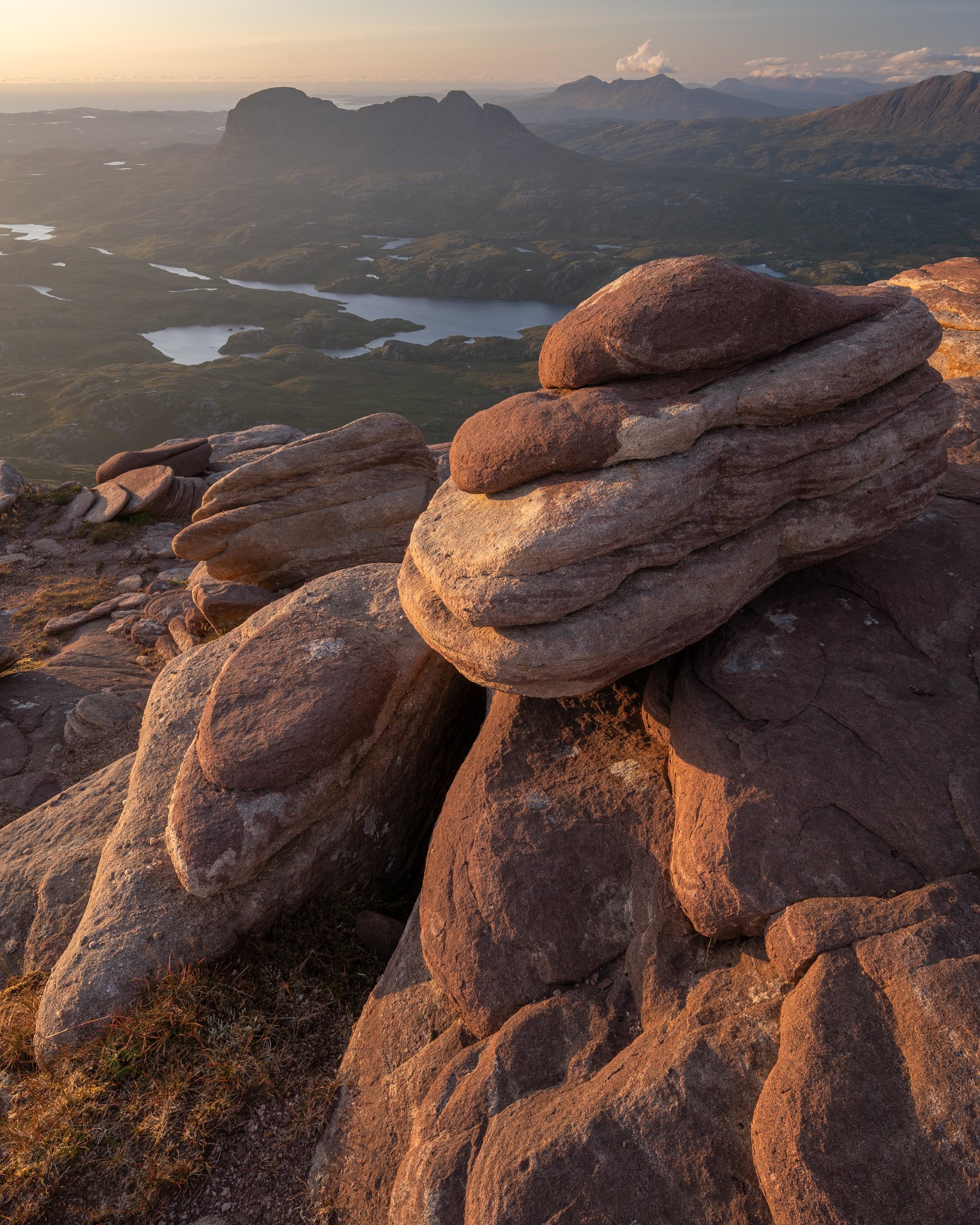
Peculiar sandstone structures on the summit.
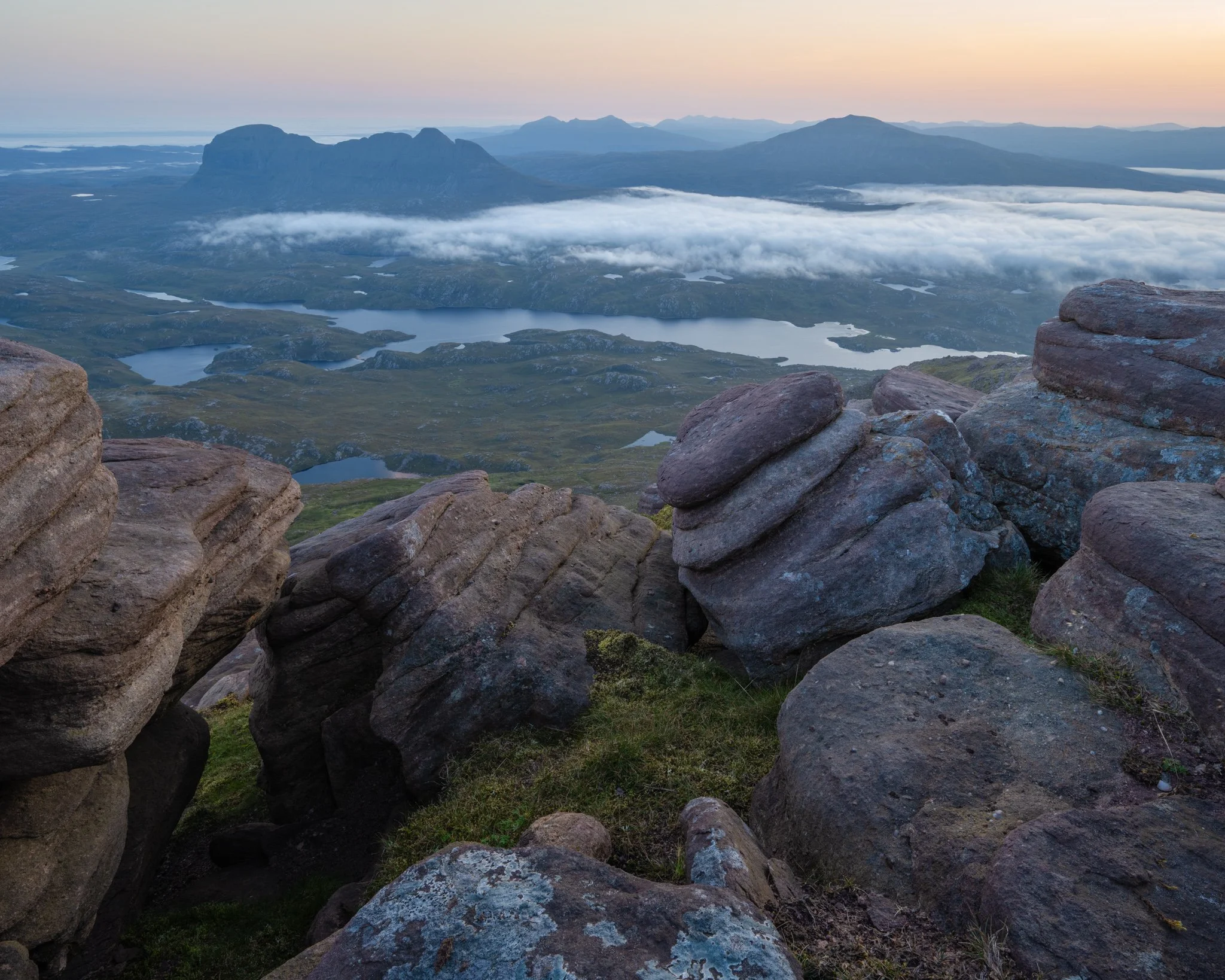
Now that’s a lineup! Suilven, Quinag, distant Foinaven and Canisp.
The views south
The summit area is quite large and it is difficult to photograph the best compositions on both the south and north aspects of the hill during the same sunset/sunrise but it can be done with a bit of determination and dashing about. For that reason I would advise getting up here early and really giving yourself plenty of time to scout various compositions before committing to your priorities. The direction of the light will definitely influence this decision.
To photograph the view south, I’d suggest first visiting the minor top of Creag nan Calman and then mooching your way west across the escarpment until you find something you are happy with. The stars of the show in this direction are the prominent Cul Beag and Stac Pollaidh, the latter looks surprisingly small from up here!
Again, there are endless foreground opportunities but they do take a little bit more seeking out than the rock-garden near the main summit with the views to the north. It is a good idea to try and include as much of Loch An Doire Dhuibh and Loch Sionasgaig in your images as you can here.
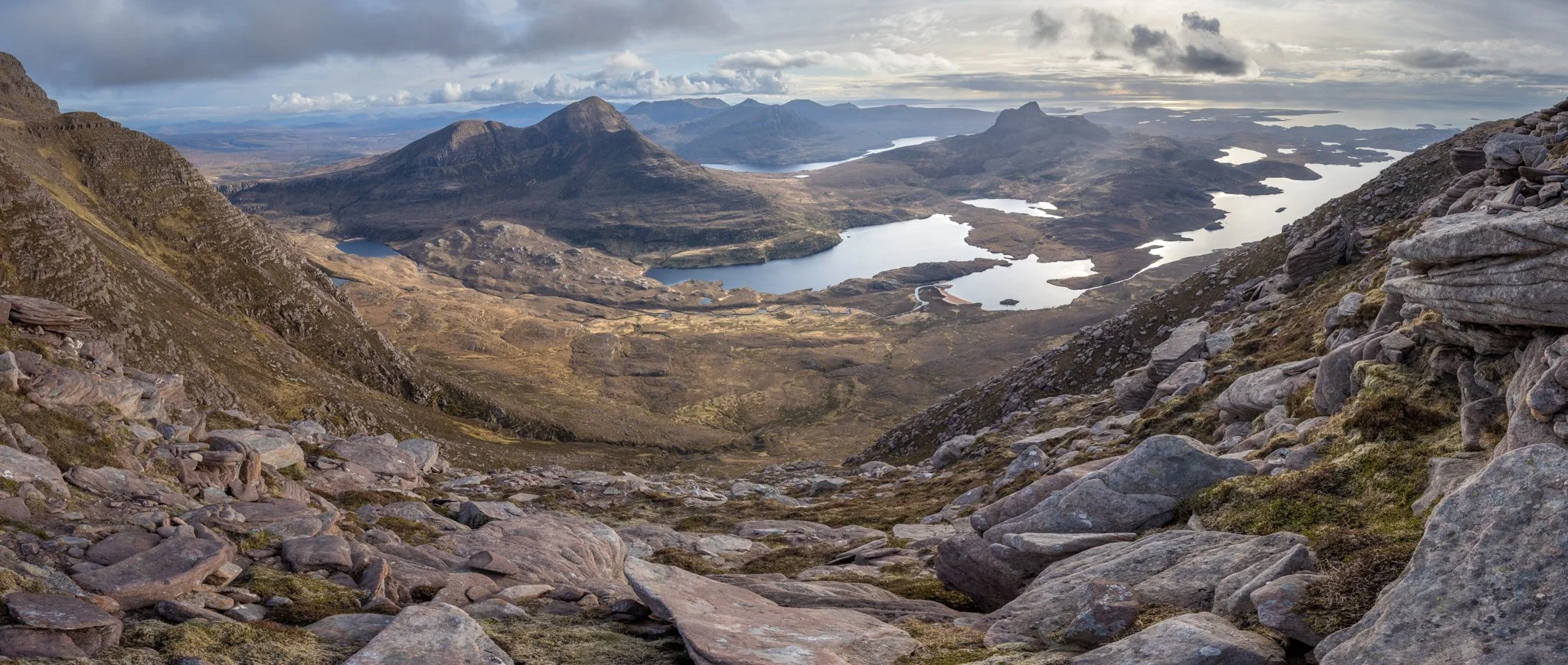
Striking indeed. Cul Beag takes centre stage. Stac Pollaidh looks miniature from up here!
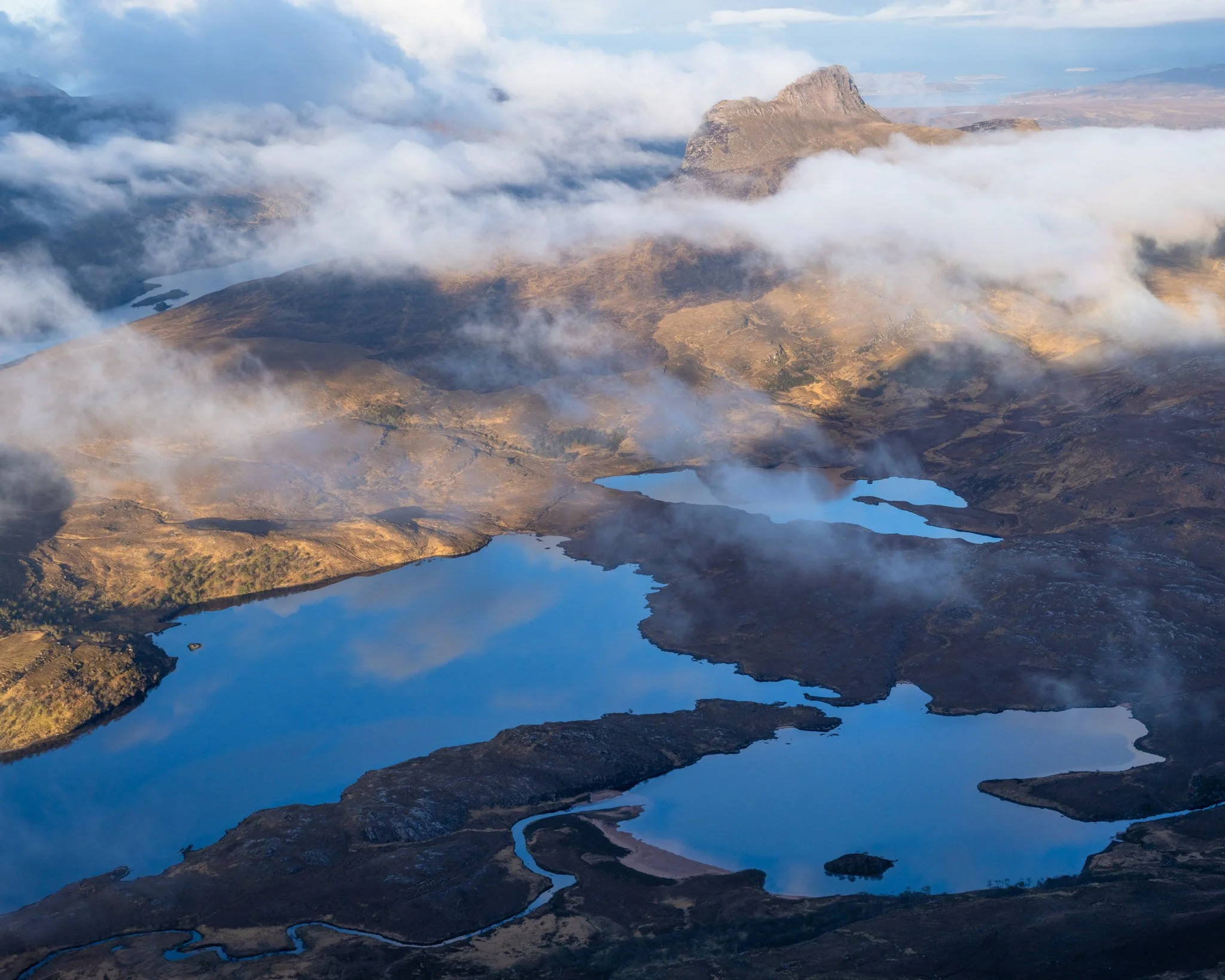
Morning mist dissipates and reveals the Stac.
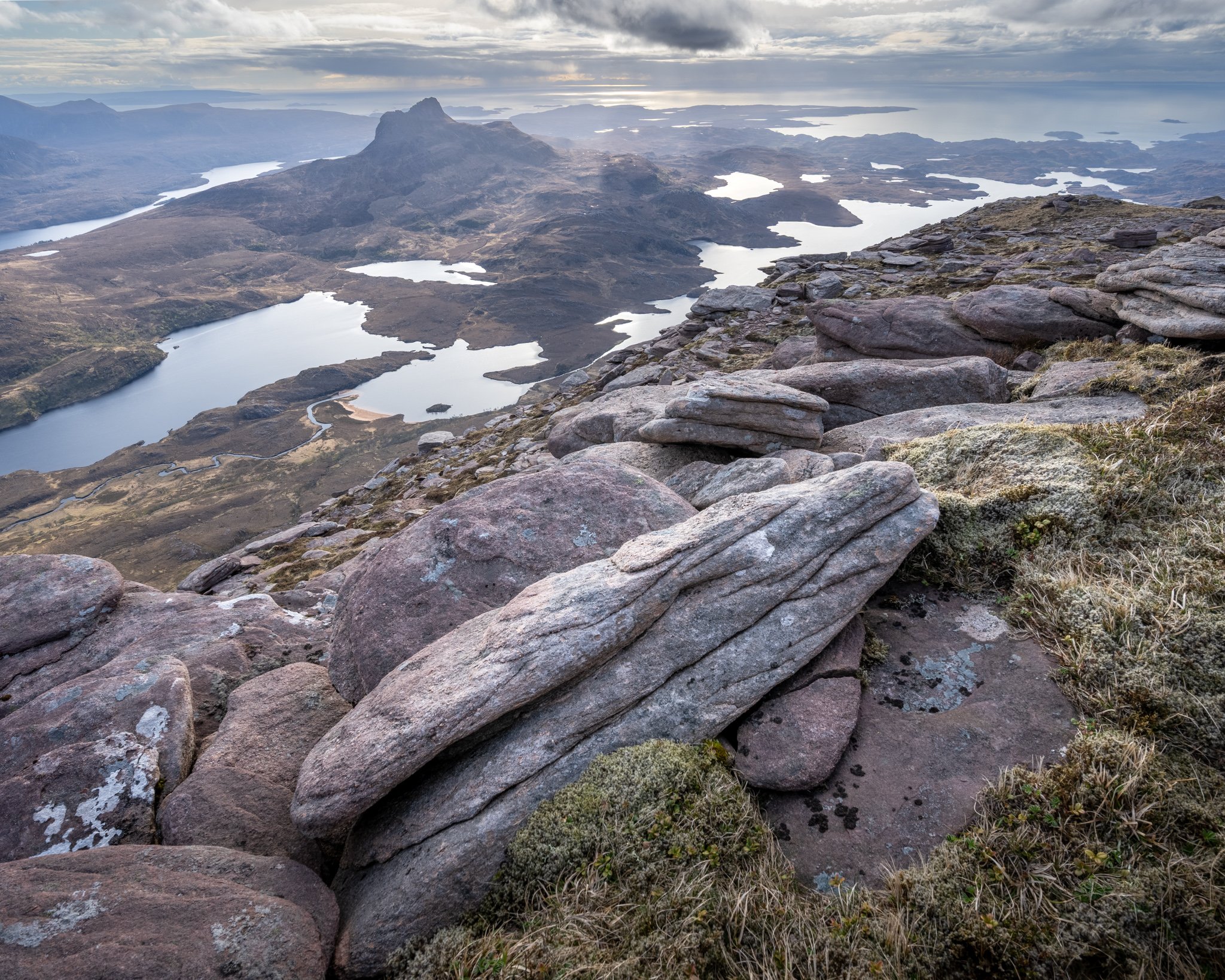
A composition I am very keen to photograph again in different light!
Essential Equipment for Photography in Assynt & Coigach
Photography equipment
Lenses: Focal range 14-300mm. Full spectrum is definitely useful here.
Tripod: Sturdy / lightweight. A good quality, sturdy and relatively lightweight tripod would be helpful because it is very often windy!
Hiking equipment
This could be a whole section in itself, particularly if you’re intending to take on the mountains. Good quality mountain equipment is generally advised for staying comfortable in the northwest Highlands of Scotland. Using a layering system with base layer (plus a spare), fleece or similar mid-layer, synthetic insulated jacket (preferable in the damp Scottish environment) and reliable waterproofs is recommended.. Winter hill walking requires additional and specific equipment AND the knowledge/skills to use them correctly.
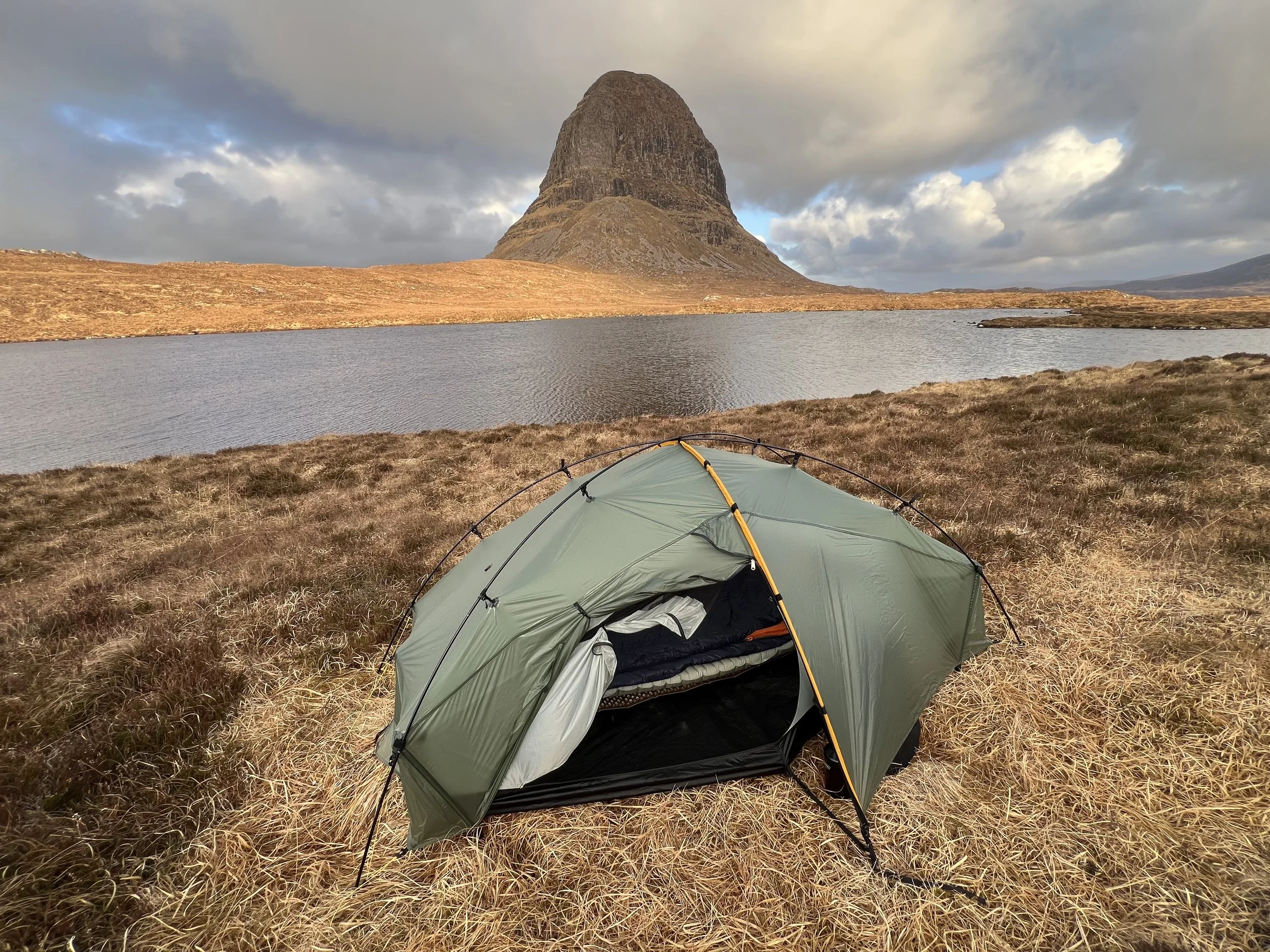
Too windy for the summit. Sturdy tent is important if camping in Assynt.