When Photography Disappears
Shelter. I needed shelter. Peering through gloved fingers as snow lashed my face, I noticed the dark clouds gathering above Beinn Alligin as the next band of precipitation swept south-east across Torridon towards me – and this one looked heavier than the last. A large boulder became the objective, a short ten metres away, but the depth of the snow was such that it was a laborious struggle, each step was a roll of the dice as to whether my leg would disappear up to my waist or just my knee. I eventually reached it, and by the time I had dug out the storm shelter and a warm layer from my rucksack, it was upon me, clattering against the outer shell as I gathered my wits inside.
Who did this moment belong to?
It isn’t easy to admit this, particularly in a public sphere, but I spend a lot of time agonising over aspects of landscape photography: finding unique locations; developing a unique style; studying weather forecasts an unhealthy amount; gathering images for a particular project or portfolio. It’s remarkable how easily this pressure can creep in. Somewhere between the planning of an expedition and the packing of the bags, the landscape quietly acquires an alternate purpose. The experience itself is no longer sufficient, and a pressure arises to produce images - one that might be worthy of the portfolio or that book project you are working on. It’s a strange type of pressure - entirely self-perpetuated. No external demand or urgency, yet I expect we all experience this from time-to-time as landscape photographers.
For me, that pressure can manifest as frustration in certain scenarios when the stars just don’t quite align – when the light has been blocked out by a bank of cloud on the horizon, for example. I’ve had my whole day ruined because some clouds have capped the top of the mountain I was stood upon. I’ve become despondent when I’ve had no sunrise or sunset for days in a row whilst on expedition. For us, there are variables that are absolutely uncontrollable, and yet we allow them to become a source of disappointment. This is one of the dangers of entering into the landscape with expectations and specific images in mind. The thing is, how might we overcome this pressure, if we cannot necessarily prevent it?
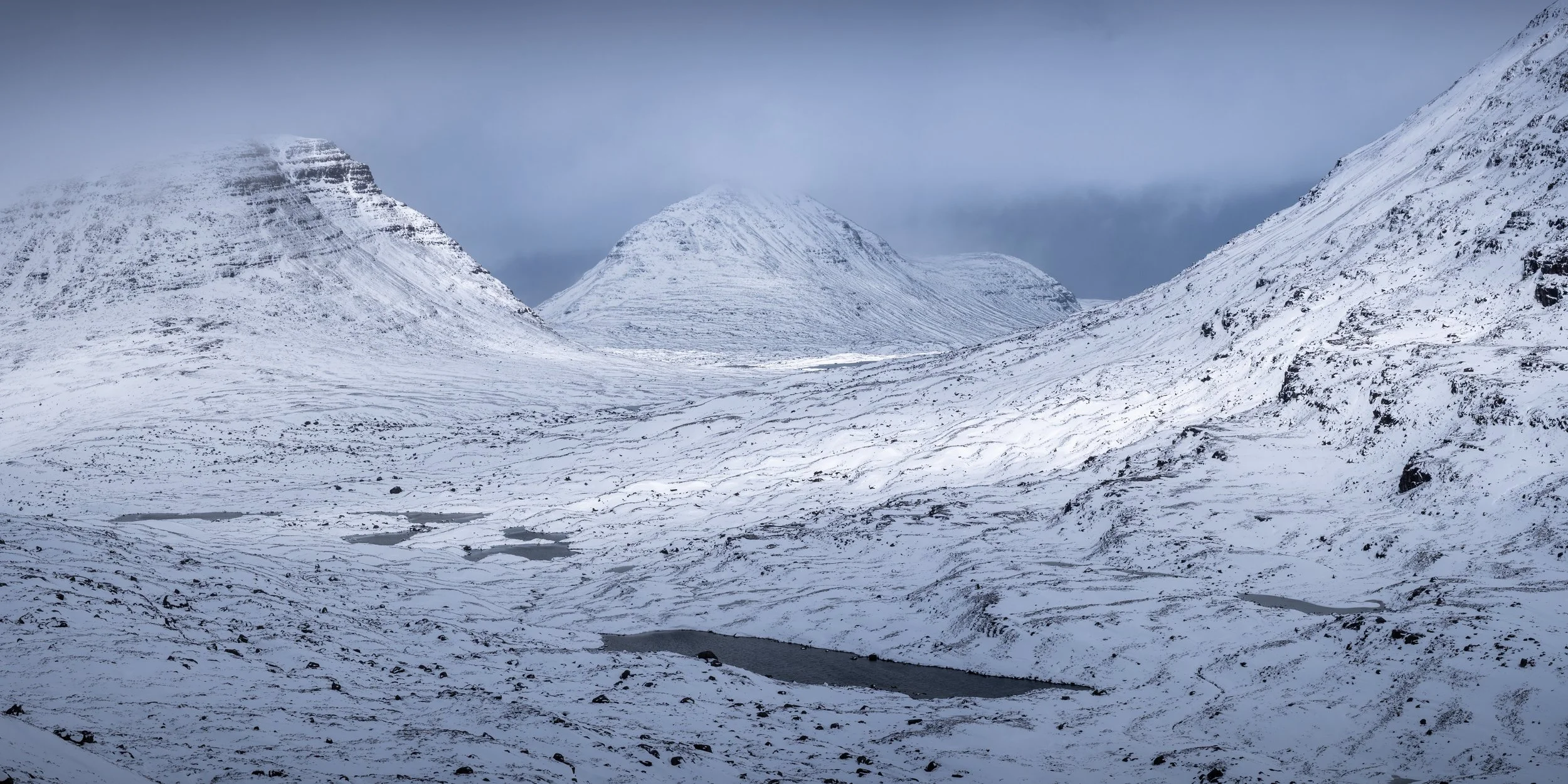
The storm that is approaching, squalls begin passing over Coire Dubh, Torridon.
I have to say, Percy Pigs are one of my favourite mountain snacks. Curled up behind the giant boulder, in the safety of my bright orange sanctuary and with a couple of sweets to hand, I felt rather toasty – perhaps it was just the sugar rush! All pre-empted visions of beautiful winter images had vanished by now. Sitting there alone in that remote location, with the brutal winter conditions that I was surrounded by, the difficulty of moving any meaningful distance across the snow and knowing the distance I still had to cover – the mind could not help but pause and contemplate ‘what am doing I here?’ instead.
In the mountains, there are often times such as this one when photography disappears entirely, the world shrinks to the practicalities of progressing through the landscape and you enter into a meditative state of self-reliance and heightened awareness. Alone, particularly in winter, you become entirely responsible. Every decision, however small, matters. There is a constant internal dialogue that anyone who has spent enough time alone in the mountains will recognise. ‘Did I charge my tracker? Where is the next reliable water source? The forecast suggested the wind would ease by now – why hasn’t it? Does this slope match the contours I just studied on the map? The rock underfoot has changed to slippery quartzite… Time to move carefully.’ It is an unending process of observation, questioning and adjusting.
Simplistic objectives replace concerns about photography: warmth trumps composition; contours instead of creativity; the next few hundred metres of ground over the grandiose long-term ambitions. I think that, as photographers, we like to believe that we are constantly observing the landscape, noticing every minuscule detail and scanning for every possible composition, but mountain photography strips that away and that is one of the reasons that I love it. The journey becomes one of endurance, perseverance, determination and decision-making, as much as it is a journey of creativity.
The pattering of snow against my shelter soon receded. Emerging, I saw the evidence of the passing squall all around. Wisps of clouds clung to the snow-clad slopes of Beinn Eighe and Beinn Dearg and what had previously looked like an immense and impenetrable wall of dark cloud now glowed softly. Narrow shafts of light broke through and reached the snowy basin of Coire Dubh. Only then did I remember that I was carrying the camera.
So if the mountains have a way of making photography disappear, what then happens when it quietly returns? I often wonder if I would still climb this mountain if I couldn't tell anybody or show the resulting images. Perhaps I would have planned a different expedition. Would I have stopped for the same fleeting beams of light? I have even spent three entire days on one mountain waiting for one extraordinary moment of light to occur in the past, without any guarantee. To answer truthfully, I would have to say no – at least, not to the same extent.
For me, hiking mountains has become so synonymous with creating images that it is almost impossible to imagine one without the other. The reason I started venturing into the mountains is because I was in constant awe of their beauty and magnificence, that much will never change. The reason I started carrying a camera up there with me was because it became a way of articulating that reverence. So, would I wade through waist deep snow to specific locations to take specific photographs if I wasn’t working a photographic project - no, probably not. Would I continue to seek out as many new adventures in the mountains and carry my camera with me on every occasion - unequivocally yes. The value in asking ourselves such questions is that it reminds us of our greatest priorities in life - for me that is to be in the mountains as often as I can be. I bring the camera because it is the instrument that draws me closer to them. It’s the bridge between simply being in the mountains and immersing in the mountains.
All was profoundly still after that. For those few minutes beneath the shelter, photography had ceased to exist and the world had been reduced to simpler concerns. The pressure to create, to produce something worthy had quietly dissolved, through no conscious effort but through physical demand placed upon me by the elements. But now the landscape was calm once more, in stark contrast to the chaos just moments ago. The hurried lunges towards that boulder were now purposeful strides as I stepped round onto its other side.
The scene presented itself to me instantly, as if it had been waiting for my arrival. As I brought the camera up and peered through the viewfinder, it no longer felt like a tool for collecting an image, it felt like a way of acknowledging what I had just experienced. Retrospectively, I realise that the photograph was not the purpose of that journey, rather, a response to the experiencing itself.
I did not have a second thought when I was composing this image. It was as if I was on auto-pilot, totally immersed in the creative experience. When I look at it now, I remember the sound of snow hammering against nylon, the relief of reaching shelter, the absurd comfort of eating Percy Pigs in such a hostile winter environment beneath the mountains and the calmness that followed. For us, the photograph is inseparable from the memory.
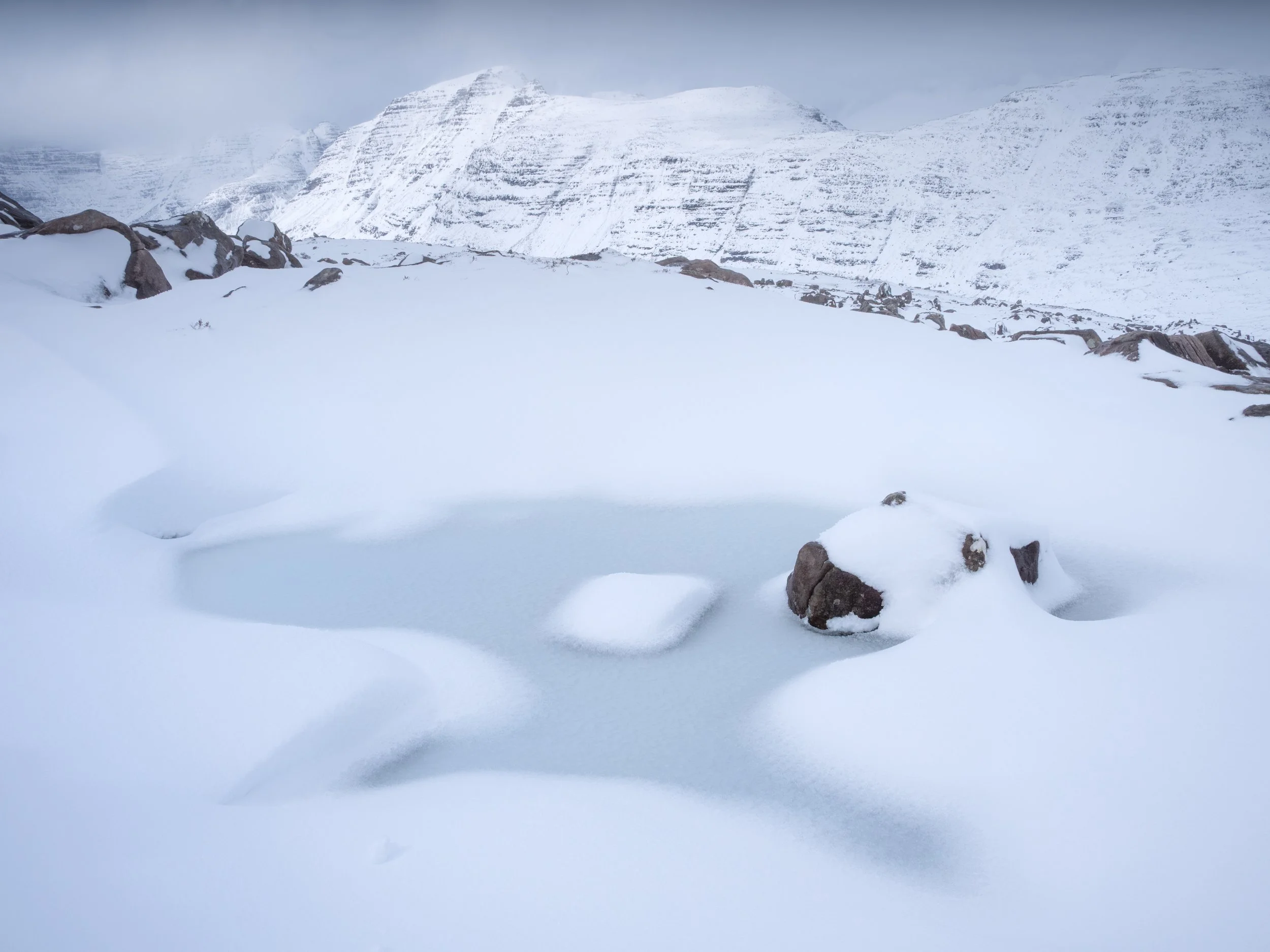
The view from my storm shelter after the squall had passed, overlooking Coire Dubh, Torridon.
I know those pressures will return. I’ll no doubt debate between one mountain or another. There will be more evenings when I hope for clear summits, dramatic skies and perfect light and I’m sure I will feel disappointment again when they don’t materialise. But now, when I feel those frustrations beginning to take hold, I’ll remember that day in Torridon behind that snow-laden boulder.
In that moment I let go of my intentions, my plans and my expectations. I experienced first and captured second. This was the power of the landscape in that moment.
So, who did this moment belong to?
Nobody. I was just the lucky one who was there to see it.